


Modern intelligent warehouses and logistics distribution centers have always faced a tricky balance between safety isolation, ventilation permeability and real-time visual management. Traditional fully solid fence panels cause poor air circulation and stuffy indoor environments, prone to moisture accumulation and mildew in humid storage areas. Conventional mesh fences have large gaps, poor privacy protection and weak wind resistance, unable to adapt to open and semi-open warehouse scenarios.
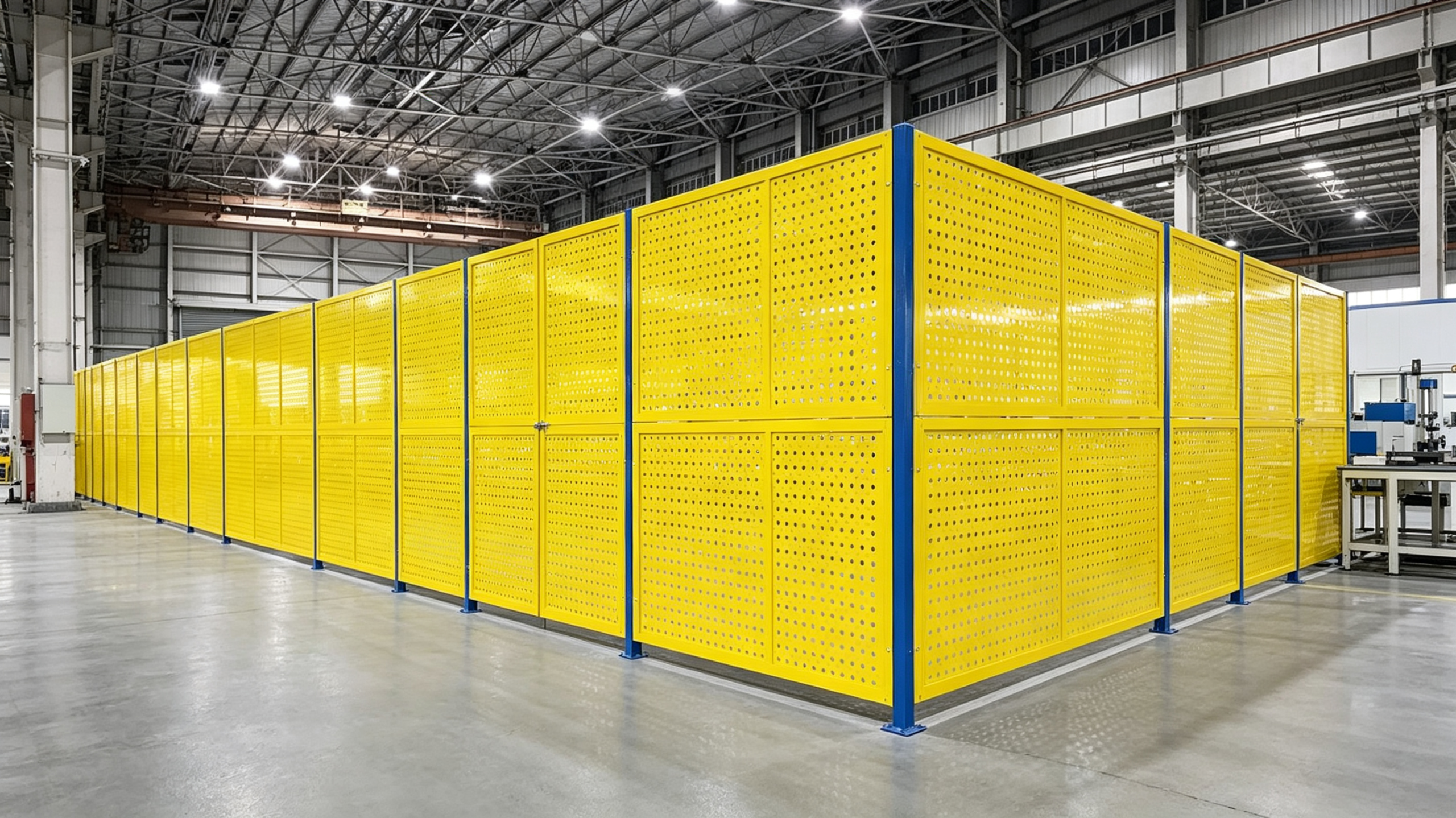
All perforated type warehouse guarding fences perfectly fill the market gap between solid panels and mesh fences. With uniform dense hole punching design, integral plate forming and high structural rigidity, they take into account ventilation, light transmission, wind resistance and safety isolation. This makes them the ideal upgrade solution for medium and high-standard industrial warehouses. BDINDUSTRIAL specializes in customized perforated safety fence systems for logistics and manufacturing scenarios. This article shares a practical large-scale logistics warehouse renovation case, detailing project pain points, customized solutions and actual operational benefits after installation.
Project Background & On-Site Safety Defects
This project belongs to a regional comprehensive logistics distribution center, covering an area of 20,000 square meters. The site integrates ordinary cargo storage, temporary transit stacking, automated sorting operation areas and staff walking passages. The warehouse features large open space, frequent internal and external air circulation, and long-term unmanned management in partial areas. The original partition facilities adopted traditional wire mesh fences, which exposed multiple management and safety problems after three years of operation, prompting a full-site safety fence upgrade.
Large Mesh Gaps Cause Poor On-Site Privacy
The traditional wire mesh fence has large and irregular grid gaps. External personnel can clearly observe internal cargo stacking and equipment operation status, failing to protect warehouse operation privacy. Meanwhile, small-sized goods and packaging accessories are easy to fall out from the mesh gaps, causing cargo loss and on-site environmental chaos, increasing daily sorting and cleaning pressure.
High Wind Pressure Leads to Unstable Fence Structure
The logistics center has many open outer corridors and semi-outdoor transit areas. Traditional mesh fences and solid fences have obvious wind resistance defects. Mesh structures are easy to shake and deform under strong wind, while solid panels bear excessive wind pressure, leading to loose column foundations and overall tilting risks. The original fence required repeated reinforcement and maintenance every year.
Uneven Structure Affects Standardized Warehouse Appearance
The welded mesh fence has uneven welding points and inconsistent grid tension. Long-term wind vibration and equipment collision cause local mesh deformation and loose welding points. The messy and inconsistent fence layout fails to meet the standardized and refined management requirements of modern logistics warehouses, and cannot pass high-standard industrial safety audits.
Poor Ventilation Causes Local Humidity Accumulation
Partial closed storage areas originally adopted solid isolation boards. Poor air circulation leads to unbalanced indoor humidity, easily causing damp deformation of packaging cargo and affecting the storage quality of daily transit goods, bringing invisible economic losses to the enterprise.
BDINDUSTRIAL Custom All Perforated Guarding Fence Solution
Combined with the logistics center’s open layout, frequent wind circulation, refined management and safety isolation needs, the BDINDUSTRIAL engineering team abandoned mesh and solid fence schemes. We customized full-plate dense perforated warehouse guarding fences with standardized hole spacing and integral stamping forming. The solution balances ventilation, wind resistance, privacy and structural stability, fully solving all pain points of the original fence system.
Integral Punching Forming Improves Overall Rigidity
Different from spliced mesh structures, BDINDUSTRIAL all perforated fences adopt one-piece steel plate stamping and forming technology without scattered welding meshes. The overall structural rigidity is greatly improved, with impact resistance 30% higher than traditional welded mesh fences. The integrated panel effectively resists daily forklift slight collision and wind vibration, no local deformation or loose gaps, maintaining long-term flat and stable status.
Uniform Dense Holes Balance Ventilation & Privacy
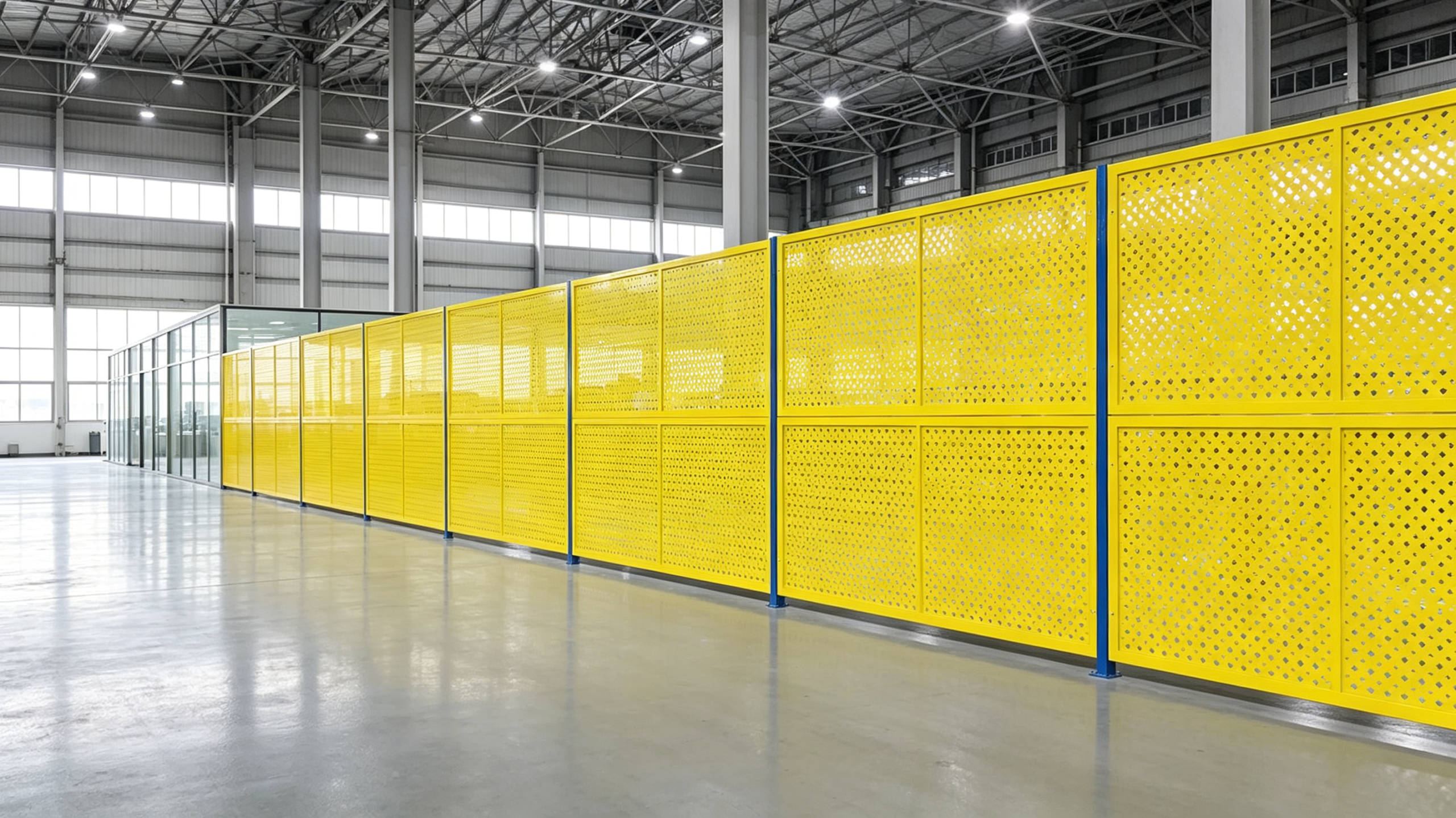
The fence adopts scientifically calculated dense perforation design with uniform hole diameter and spacing. The dense holes ensure smooth air circulation inside and outside the warehouse, eliminate local humidity accumulation, and keep the storage environment dry and breathable. At the same time, the dense hole structure blocks direct line of sight, protecting internal warehouse operation privacy without affecting daily manual patrol and camera monitoring.
Porous Structure Reduces Wind Load & Enhances Stability
For semi-outdoor and open corridor areas, the perforated structure effectively disperses and reduces lateral wind pressure, avoiding the overall overturning risk of solid fences under strong wind. Compared with mesh fences that are easy to vibrate and deform, the integral perforated panel has stronger wind resistance and structural stability, adapting to long-term outdoor and open wind environment operation.
Full Anti-Corrosion Treatment Adapts to Complex Environments
All perforated panels and supporting columns undergo hot-dip galvanizing and electrostatic powder spraying dual anti-corrosion treatment. The smooth panel surface has no dead corners for dust accumulation, with excellent dust-proof and easy-clean performance. It can resist warehouse dust, humid air and seasonal wind and rain erosion, effectively avoiding rust and aging failure.
Modular Assembly for Fast Installation & Flexible Adjustment
The fence adopts standardized modular assembly structure, with precise matching between panels and frames. No on-site welding is required, greatly shortening the construction cycle. The detachable structure supports later warehouse layout adjustment, functional area upgrading and fence reuse, with high flexibility and low long-term renovation cost.
Post-Installation Operation Effects & Project Advantages
After the completion of the BDINDUSTRIAL all perforated type warehouse guarding fence renovation, the overall safety management level and environmental standardization of the logistics center have been comprehensively improved. After one year of continuous operation, all fence panels remain flat and vertical without deformation, rust or loose structures.
The dense perforated design realizes uniform air circulation inside the warehouse, completely solving the problem of local humidity accumulation and cargo damp damage. The wind-resistant structure adapts to open-site strong wind weather, eliminating annual fence reinforcement and maintenance work. The semi-privacy perforated structure protects internal operation information while ensuring unobstructed manual and camera monitoring. The neat and unified fence layout helps the enterprise successfully pass multiple logistics safety standard audits, greatly optimizing the refined management image of the warehouse.
In addition, the zero-deformation and low-maintenance performance of the integral perforated panel reduces long-term operational maintenance costs, bringing stable and cost-effective safety protection for daily warehouse operation.
Core Advantages of BDINDUSTRIAL All Perforated Warehouse Fence
Dual Advantages of Ventilation & Privacy Protection
The dense uniform hole design avoids the poor ventilation of solid fences and the privacy leakage of mesh fences. It maintains air circulation balance in the warehouse, prevents moisture and mildew, and isolates external line of sight, realizing safety and practicality in one.
Low Wind Load & Strong Structural Stability
The porous pressure-reducing structure effectively reduces wind impact force, suitable for open logistics yards, semi-outdoor corridors and windy coastal warehouses. It is not easy to shake and deform, with far stronger weather resistance than traditional mesh fences.
Integral Panel High Impact Resistance
One-piece stamping forming eliminates weak welding points. The overall stress is uniform, which can resist daily forklift bumps and cargo extrusion. It will not produce local mesh breakage and gap deformation, ensuring long-term safety isolation performance.
Easy to Clean & Low Daily Maintenance
The smooth integral plate surface has no messy grid gaps, not easy to accumulate dust and debris. Daily cleaning only needs simple wiping and flushing, no frequent gap sorting and rust removal maintenance, saving enterprise operational costs.
Main Application Scenarios of All Perforated Fences
Open & Semi-Open Logistics Warehouses
Suitable for large-space warehouses with high ventilation requirements and frequent air circulation to balance safety isolation and environmental ventilation.
Wind-Prone Coastal & Outdoor Storage Yards
The low wind load structure enhances wind resistance, avoiding fence deformation and overturning caused by seasonal strong winds.
Refined Management Intelligent Warehouses
Neat and unified appearance meets modern warehouse standardized construction standards, supporting refined safety management and audit assessment.
Light Industrial Production & Transit Workshops
Ensure on-site operation privacy while maintaining air permeability, suitable for light industrial workshops and transit storage scenarios.
If you need high ventilation, wind-resistant and standardized all perforated type warehouse guarding fence solutions for warehouse renovation and new projects, contact BDINDUSTRIAL. We provide free on-site survey, personalized scheme customization, global factory direct supply and full-cycle after-sales technical support.
FAQ
1. What is the difference between all perforated fence and traditional mesh fence?
All perforated fences adopt integral steel plate stamping forming with uniform dense holes and no scattered welding points. They have higher structural rigidity and impact resistance, not easy to deform. Different from mesh fences with large gaps and poor privacy, perforated fences balance ventilation and privacy, feature stronger wind resistance and neater appearance, and require almost no daily maintenance, more suitable for high-standard modern warehouses.
2. Will the perforated structure affect warehouse safety isolation performance?
No. BDINDUSTRIAL designs hole diameter and spacing strictly according to industrial safety standards. The dense small-hole structure prevents personnel from climbing and crossing, and avoids small cargo falling out. While ensuring air and light transmission, it completely meets industrial safety isolation specifications, and will not reduce the protective performance of the fence.
3. Is perforated fence suitable for windy outdoor warehouse scenarios?
It is very suitable and is the optimal choice for windy areas. The porous structure can disperse wind pressure and reduce the lateral load borne by the fence. It effectively avoids the overall shaking, tilting and overturning problems of solid fences and thin mesh fences under strong wind, with excellent outdoor weather resistance.
4. Does perforated warehouse fence have dust accumulation and cleaning problems?
Almost no dust accumulation trouble. The integral smooth plate surface has no complex grid dead corners. Dust and debris are not easy to adhere and accumulate. Daily cleaning only needs simple water flushing and wiping, which is more labor-saving and efficient than mesh fences, fully adapting to long-term warehouse use.
5. Can BDINDUSTRIAL customize hole size and spacing of perforated fences?
Yes. We provide full personalized customization services. According to customer warehouse ventilation demand, privacy standard and safety specifications, we can adjust hole diameter, hole spacing, plate thickness and fence height to match different industrial and logistics scenarios, ensuring the best on-site use effect.