


A CNC fiber laser cutting machine can process large metal sheets with very little manual handling. However, the equipment area often includes more than the laser machine itself.
Automatic loading tables, sheet storage, unloading conveyors, robotic handling equipment, and maintenance stations all take up space around the cutting system.
For sheet metal manufacturers and automation integrators, this creates an important design question: how should the surrounding equipment area be protected without interfering with material movement?
A machine guarding fence can help create a controlled boundary around the wider production cell. However, it must be designed for the correct purpose.
In this guide, BDINDUSTRIAL explains where welded mesh machine guarding fits into a CNC laser cutting installation, what buyers should consider before ordering, and which technical details should be confirmed with the equipment manufacturer.
01. The Laser Machine Is Only Part of the Working Area
Consider a factory installing a 6 kW fiber laser cutting machine with automatic sheet loading and unloading.
The machine itself may already have a protective enclosure. However, workers and material handling equipment still need to operate around it.
The complete installation may include:
- Raw sheet metal storage.
- Automatic loading tables.
- Laser cutting equipment.
- Finished sheet unloading conveyors.
- Scrap collection areas.
- Electrical cabinets and maintenance stations.
- Robotic material handling equipment.
Each area has different access requirements.
For example, the loading station needs enough space for sheet movement, while the maintenance area requires access to electrical and mechanical components.
Installing a fence around the machine without considering these activities can create unnecessary obstacles.
The first step is to plan the entire production cell, not just measure the laser machine.
02. Where Does a Machine Guarding Fence Fit?
The Machine Guarding Fence is designed for physical separation around industrial equipment and automated working areas.
For CNC laser cutting installations, it can serve several purposes.
Around Automatic Loading and Unloading Equipment
Automatic sheet handling systems contain moving mechanisms that require suitable access control.
A perimeter fence can help separate these equipment areas from pedestrian routes.
However, the loading and unloading openings must be designed around the actual sheet dimensions and handling sequence.
Around Robotic Handling Stations
Some laser cutting facilities use robots to move metal sheets or transfer finished components.
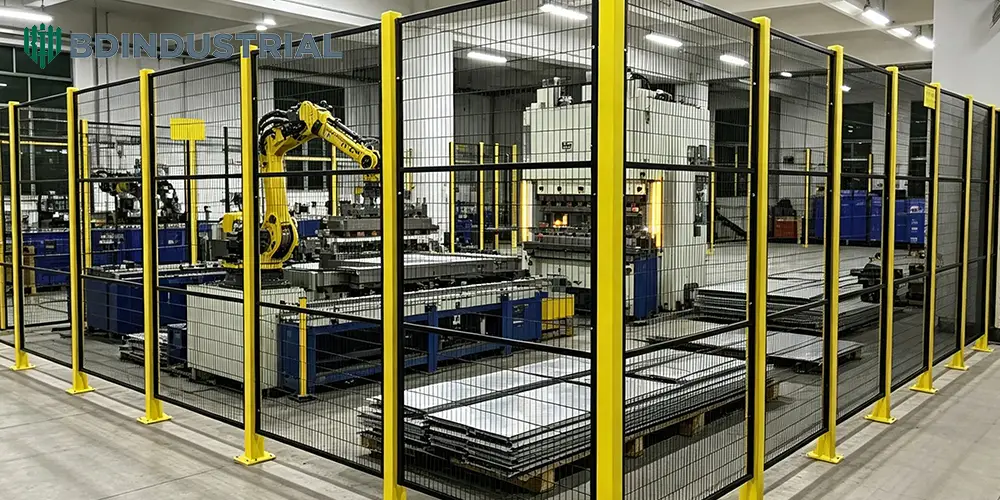
A modular welded mesh enclosure can create a defined boundary around these robot operating areas.
The fence layout should account for the robot’s full movement envelope, including the workpiece and end-effector.
Around Restricted Equipment Areas
Supporting equipment, conveyors, and other automated mechanisms may require separate access boundaries.
Fence panels can help organize these areas while maintaining visibility for operators.
Around Maintenance Access Points
Technicians need access to selected components for inspection and servicing.
A suitable gate or removable panel can provide controlled access without requiring the entire enclosure to be dismantled.
03. An Important Difference: Mesh Fencing Is Not Laser Protection
This is a technical detail that every laser equipment buyer should understand.
A standard welded mesh machine guarding fence is not designed to contain high-power laser radiation.
A laser cutting machine may require a dedicated protective enclosure with appropriately tested laser guards, viewing windows, doors, and interlocking systems.
The laser protection must match the laser wavelength, power, exposure conditions, and foreseeable operating risks.
Therefore, the two systems have different functions:
| Protection System | Main Function |
|---|---|
| Laser-Rated Machine Enclosure | Contains hazardous laser radiation |
| Machine Guarding Fence | Separates surrounding equipment and restricted working areas |
| Safety Interlocking | Controls access and hazardous machine operation |
| Loading and Unloading Guards | Protects access around material handling mechanisms |
| Direct Machine Guards | Protects specific moving components |
For example, a laser machine may already have a fully enclosed cutting chamber.
A separate Machine Guarding Fence can then be used around associated robotic handling equipment or other restricted areas.
However, an ordinary mesh fence must never replace a laser-rated enclosure or be used as an unverified laser barrier.
For projects involving laser processing equipment, engineers should review:
- ISO 11553-1:2020 — Safety of laser processing machines.
- IEC 60825-4:2022 — Requirements for laser guards.
Both standards address laser-related safety requirements, but they serve different roles in the complete machine design.
04. Choosing the Right Panel Structure
Not every section of a laser cutting production cell needs the same panel configuration.
The choice depends on the equipment layout, visibility requirements, and access conditions.
Welded Mesh Panels
Welded mesh panels are suitable for many general equipment separation applications.
They allow operators to observe surrounding machinery and provide an open structure for airflow.
BDINDUSTRIAL’s Machine Guarding Fence range offers:
- Panel width: 0.5–2.0 m.
- Panel height: 1.2 m, 1.5 m, and 2.0 m.
- Wire diameter: 3.0 mm and 4.0 mm.
- Mesh opening: 20 × 100 mm.
- Frame tube: 20 × 20 mm.
These are reference product specifications. Final dimensions should match the project requirements and safety assessment.
Sheet Metal Panels
Some equipment areas may require a more enclosed visual barrier.
The product range also includes sheet metal panels and sheet metal panels with viewing windows.
These options may suit selected areas where the buyer needs a different balance of visibility and separation.
However, ordinary sheet metal panels are not automatically suitable for laser radiation protection. Any panel intended to serve as a laser guard requires appropriate material assessment, testing, and validation.
05. Plan Material Movement Before Positioning Fence Posts
Laser cutting machines often process large sheets of steel, aluminum, or stainless steel.
These materials may move through the factory using vacuum lifting systems, loading tables, roller conveyors, or forklifts.
A fence post placed in the wrong position can interfere with the entire handling process.
Before approving the layout, check the following.
Maximum Sheet Dimensions
Record the largest sheet length, width, and thickness.
Loading Table Position
Confirm how the sheet enters the cutting machine and whether the table moves during operation.
Unloading Direction
Identify where finished sheets and cut components leave the machine.
Material Handling Equipment
Check the movement envelope of vacuum lifters, forklifts, and automatic handling systems.
Maintenance Clearance
Leave sufficient space for access to the machine’s service panels, motors, and electrical cabinets.
For automated production cells, these dimensions should be shown on the same drawing as the proposed fence layout.
06. Access Gates: Swing, Sliding or Removable?
Laser cutting installations may require different access arrangements.
The best option depends on the opening width, nearby equipment, and maintenance procedures.
| Gate Type | Suitable Application | Main Consideration |
|---|---|---|
| Swing Gate | Regular personnel access | Opening clearance |
| Sliding Gate | Wider equipment access | Side travel space |
| Double Swing Gate | Larger maintenance openings | Gate support and swing area |
| Removable Panel | Occasional equipment servicing | Secure connection and removal procedure |
BDINDUSTRIAL provides optional swing gate hinges and four-wheel sliding gate roller assemblies.
For a large sheet handling station, a wider gate may be more practical than a standard pedestrian entrance.
However, the gate arrangement must not create uncontrolled access to hazardous equipment.
Where opening a gate exposes workers to dangerous machine movement, the system integrator should specify suitable safety interlocking or guard locking.
07. Post Specifications and Installation Details
A machine guarding fence is only as practical as its supporting structure.
For a laser cutting cell, the panel and post arrangement should match the equipment dimensions and installation conditions.
The current BDINDUSTRIAL product range includes the following post options.
| Specification | Reference Options |
|---|---|
| Post Type | Square Steel Tube |
| Post Size | 60 × 60 mm |
| Wall Thickness | 1.0 / 1.5 / 2.0 / 2.5 / 3.0 mm |
| Post Length | 1.2–2.0 m |
| Panel Connection | Spider Clips |
| Fasteners | Security Bolts and Matching Nuts |
| Installation | Floor-Mounted with Suitable Fixings |
Before manufacturing, engineers should confirm:
- Post center-to-center distances.
- Panel connection gaps.
- Base plate dimensions.
- Concrete floor conditions.
- Anchor positions.
- Gate post reinforcement.
- Required installation clearances.
These details become particularly important when the fence needs to fit around existing machinery.
08. Surface Treatment for Metal Processing Facilities
Metal fabrication facilities may expose fencing to dust, oil, humidity, and regular cleaning.
Therefore, surface treatment should match the actual working environment.
Common options include:
Powder Coating
Suitable for many indoor industrial applications where a finished appearance and specified color are required.
Hot-Dip Galvanizing
Can be considered where stronger corrosion protection is needed.
PVC Coating
An additional coating option for selected industrial environments.
For factories in Australia, Malaysia, Vietnam, and Thailand, buyers should consider humidity, coastal exposure, cleaning methods, and the expected service conditions before selecting the finish.
The final coating specification should be agreed before production.
09. What Should You Include in a Laser Cutting Fence RFQ?
When requesting a quotation, do not send only the machine model and total fence length.
The manufacturer needs enough information to understand the equipment layout.
| RFQ Item | Information Required |
|---|---|
| Machine Type | Fiber Laser Cutting Machine |
| Laser Machine Dimensions | Length, width, and height |
| Loading System | Manual or automatic |
| Unloading System | Conveyor, robot, or other |
| Maximum Sheet Size | Length, width, and thickness |
| Robot Information | Model and operating area, if applicable |
| Fence Height | Required height |
| Panel Specifications | Mesh or sheet metal panel |
| Post Specifications | Size and thickness |
| Gate Type | Swing, sliding, or removable |
| Surface Treatment | Powder coated or galvanized |
| Quantity | Total panels, posts, and accessories |
| Drawings | CAD Layout or Equipment Drawings |
| Destination | Country and delivery location |
For complex projects, a 2D or 3D machine layout is particularly useful.
BDINDUSTRIAL CAD Support helps buyers review panel dimensions, post positions, and gate arrangements before manufacturing.
The laser machine manufacturer or responsible safety integrator should separately approve all laser protection and machine safety functions.
10. Why Work with BDINDUSTRIAL?
For overseas machinery projects, buyers need more than standard mesh panels.
They need a manufacturer that can understand custom dimensions, connection details, gate requirements, and project drawings.
BDINDUSTRIAL focuses on Machine Guarding Fence manufacturing for industrial equipment and automated production environments.
Our product and project support includes:
- Welded mesh machine guarding panels.
- Sheet metal panels and panels with viewing windows.
- Customized steel frames and supporting posts.
- Swing and sliding gate accessories.
- Custom panel dimensions.
- CAD drawing confirmation.
- Bulk manufacturing and export packaging.
Whether you are a laser machine OEM, metal fabrication contractor, or automation integrator, we can discuss your perimeter guarding requirements based on the actual equipment layout.
Request a Custom Machine Guarding Fence Quotation
A CNC laser cutting cell requires careful coordination between the machine enclosure, material handling equipment, and surrounding working areas.
The right perimeter fence should help organize the equipment area without interfering with loading, unloading, or maintenance.
BDINDUSTRIAL supplies customized Machine Guarding Fence panels, posts, connections, and gate hardware for international industrial projects.
Send us your laser cutting machine layout, required fence dimensions, access gate specifications, estimated quantity, and destination country.
Contact BDINDUSTRIAL to discuss your project and request a manufacturing quotation.
Contact Information
Company: BDINDUSTRIAL
Email: info@bd-fence.com
Mobile: +86 18703182863
WhatsApp: +86 18703287372
Website: https://bendinfence.com