


As robotic automation becomes standard in modern manufacturing, robot cell safety guarding has evolved from simple area separation into a core part of factory safety compliance. Many automation integrators and factory owners run into practical issues on site. Generic light-duty mesh fences deform after long-term robot vibration or accidental arm collision, causing frequent safety switch misalignment and unexpected production downtime. Improper fence spacing and unstable structures also lead to failed safety audits, delayed project handover and increased operational risks.
A professional industrial robot safety fence is engineered specifically for robot working cells. It features anti-vibration structure, impact resistance and standard-compliant mesh spacing, ensuring physical isolation and collaborative safety. BDINDUSTRIAL specializes in custom robot cell safety fencing solutions for global automated factories. We have completed hundreds of successful robot safety fence projects across Europe, Southeast Asia, the Middle East and North America, helping enterprises build stable, audit-friendly and low-maintenance robot workstation safety systems.

Key On-Site Safety Risks Solved by Robot Safety Fence
Unauthorized Personnel Entry Causes Collision Accidents
Industrial robotic arms operate at high speed with large working radii and invisible hazard zones. Without standardized physical isolation, workers or temporary staff may accidentally enter robot operating areas during equipment operation, adjustment or patrol inspection. This easily causes mechanical collision injuries and emergency shutdowns, affecting continuous production progress. Traditional warning tapes and signage cannot form mandatory safety restrictions, with extremely poor protection effect.
Low-Grade Fence Deformation Triggers Frequent False Alarms
Most ordinary mesh fences lack reinforced frames. After long-term robot vibration and minor equipment impact, panels sag and deform, resulting in misaligned safety interlock switches. This triggers frequent PLC false trips and unplanned downtime. For mass production automated lines, repeated startup and shutdown greatly reduces production efficiency and increases equipment loss.
Unstandard Mesh Spacing Fails International Safety Audits
Global industrial robot safety management follows strict ISO 13857 safety standards. Many ordinary fences have unreasonable mesh aperture and isolation height, which cannot prevent finger stretching and body intrusion. Non-standard guarding layout directly leads to safety audit failure, forcing factories to rectify and replace equipment, resulting in unnecessary project cost waste and schedule delays.
Difficult Maintenance Access Affects Equipment Iteration
Welded fixed fences and non-modular guarding structures block maintenance passages. When robot equipment fails or needs regular maintenance and program upgrading, workers spend a lot of time disassembling fences. It greatly increases maintenance time and affects production line iteration efficiency, unable to adapt to flexible modern automated production modes.
BDINDUSTRIAL Global Industrial Robot Safety Fence Typical Cases
European Automotive Robot Welding Cell Guarding Project
A European auto parts manufacturing factory has multiple automated robot welding cells. The original ordinary mesh safety fences had no reinforced frames. After one year of continuous robot vibration and welding spatter impact, partial mesh deformed and loosened, causing frequent safety switch false alarms. The non-standard mesh spacing also brought hidden dangers of personnel accidental contact, failing to meet local European industrial safety audit standards.
BDINDUSTRIAL provided customized framed reinforced robot safety fences for the project. We adopted standard finger-safe mesh spacing compliant with ISO safety regulations, effectively preventing personnel hand intrusion. The integral thickened frame structure disperses robot vibration and instantaneous impact force, avoiding panel deformation and switch misalignment. The powder-coated surface resists welding spatter adhesion and high-temperature aging. After installation, the robot cell operates stably without false shutdowns, smoothly passing local safety certification and greatly improving workshop operational stability.
Southeast Asia New Energy Assembly Robot Cell Project
A new energy equipment assembly factory in Southeast Asia has compact workshop space and densely arranged robot assembly stations. The local high temperature and humid climate makes ordinary steel fences prone to rust and paint peeling. Meanwhile, the production line needs frequent layout adjustment and robot program iteration, requiring flexible and reusable safety isolation facilities. Fixed welded fences seriously restrict workshop flexible production.
We adopted modular hot-dip galvanized robot safety fences for this project. The anti-corrosion surface treatment adapts to local high humidity and high temperature environment, effectively preventing rust and aging. The full bolt assembly structure requires no on-site welding, supporting free disassembly and rearrangement. We reserved professional maintenance access doors and safety interlock mounting positions according to robot layout, facilitating daily equipment maintenance and line adjustment. The flexible guarding solution perfectly matches the lean production mode of new energy workshops.
Middle East Intelligent Factory Multi-Robot Zoning Project
An intelligent manufacturing factory in the Middle East adopts full-process robotic operation, with multiple robot working cells distributed intensively. The open workshop faces strong long-term ultraviolet radiation and dry dusty environment. Ordinary fences fade and age rapidly, with poor overall rigidity, unable to resist accidental collision of robotic arms and AGV handling equipment. The client required high-rigidity, anti-aging and highly standardized robot safety zoning system.
BDINDUSTRIAL customized UV-resistant electrostatic powder-coated robot safety fences for the project. The high-strength framed structure has strong impact resistance, which can bear instantaneous collision of robotic arms and daily AGV scraping without deformation. The anti-UV coating avoids color fading and aging under long-term strong sunlight. Standardized modular panels unify the overall workshop style, realizing clear zoning of multiple robot cells. The project greatly improves workshop safety management level and passes international industrial safety inspection with zero defects.
Core Advantages of BDINDUSTRIAL Robot Safety Fence
ISO Standard Compliance to Meet Global Audit Requirements
All our robot safety fences are designed and produced in strict accordance with ISO 13857 and OSHA industrial safety standards. Standardized mesh aperture, safety height and isolation spacing effectively prevent personnel intrusion and finger stretching risks. The product parameters meet safety certification requirements of Europe, Southeast Asia, Middle East and other global regions, helping projects pass safety audits efficiently without secondary rectification.
Reinforced Framed Structure Anti-Vibration & Anti-Impact
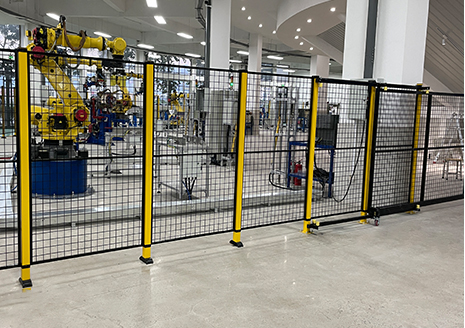
Different from frameless ordinary mesh fences, our robot-specific fences adopt thickened integral reinforced frames. The structural stress is uniform and stable, which can long-term resist robot operation vibration, instantaneous arm collision and daily AGV scraping. It effectively avoids panel sagging, deformation and safety switch misalignment, eliminating frequent false shutdown faults caused by fence structural problems.
Diversified Surface Treatment Adapt to Global Environments
We configure targeted surface processes according to different global climates. Hot-dip galvanized fences adapt to coastal humidity and high-corrosion environments. UV-resistant powder-coated products suit high-temperature dry and strong light outdoor and indoor workshops. All products resist rust, aging and spatter adhesion, maintaining long-term stable appearance and performance, reducing frequent replacement and maintenance costs.
Modular Design Supports Flexible Maintenance & Iteration
Adopting full modular bolt assembly design, no on-site welding and cutting is required. The dismountable structure supports repeated disassembly, rearrangement and reuse. We can reserve safety door positions, interlock switch mounting holes and maintenance passages according to robot cell layout, greatly improving equipment maintenance efficiency and meeting flexible layout adjustment needs of modern automated factories.
Professional Customization for Complex Robot Layouts
We support full non-standard customization for special robot working radii, compact workshop spaces and multi-cell intensive layouts. We can adjust fence height, panel size, mesh specification and accessory types, and customize special-shaped corners and transition parts. Perfectly fit various complex robot workstation zoning demands, realizing one-stop compliant safety guarding solutions.
If you need standard-compliant, anti-impact and flexible industrial robot safety fences for automated workshop renovation and robot cell construction projects worldwide, contact BDINDUSTRIAL. We provide free layout design, professional safety scheme matching, factory direct price and full-cycle cross-border after-sales technical support.
FAQ
1. Why are professional robot safety fences different from ordinary industrial fences?
Professional robot safety fences are specially engineered for high-frequency vibration and accidental impact scenarios of robot cells. They adopt reinforced framed structures and ISO-standard finger-safe mesh spacing, effectively avoiding deformation false alarms and safety audit failures. Ordinary light-duty fences cannot resist long-term robot vibration, prone to sagging and loose joints, which cannot meet automated workshop safety standards.
2. Can your robot safety fence match safety interlock and sensor systems?
Yes. Our robot safety fences reserve standard mounting positions for mainstream safety interlocks, RFID sensors and access switches. No on-site drilling and modification is needed, realizing seamless docking with automation control systems. It ensures linkage safety protection and improves the overall intelligent safety management level of robot cells.
3. Do your products meet global international robot safety standards?
All BDINDUSTRIAL robot safety fences comply with ISO 13857 and OSHA industrial safety specifications. The fence height, mesh spacing and structural impact resistance fully meet the safety audit requirements of Europe, America, Southeast Asia, Middle East and other regions. We can provide relevant qualification documents to support project acceptance.
4. Is the modular robot safety fence convenient for later maintenance and line adjustment?
Very convenient. The bolt assembly modular structure allows free disassembly and reassembly. When robot equipment needs maintenance, program upgrading or production line layout adjustment, the fence can be partially or fully disassembled quickly without damage. It can be reused after rearrangement, greatly saving long-term factory renovation costs.
5. Can you customize exclusive solutions for compact robot cells?
Absolutely. For compact workshop spaces and densely arranged multi-robot cells, our engineering team can optimize fence spacing, mesh specifications and passage layouts according to site conditions. Custom narrow-size panels and special transition accessories maximize space utilization while ensuring safety compliance, solving the guarding difficulty of limited workshop space.