


Modern automated manufacturing factories rely heavily on robotic arms, stamping equipment, rotating machinery and assembly line devices to improve production efficiency. While intelligent equipment boosts output, exposed moving parts, high-speed operating areas and automated working zones bring major safety risks to on-site operators. Many old factories use simple guardrails, warning tapes or temporary isolation facilities for machine protection, which cannot meet standardized industrial safety management requirements.
Unstandardized machine isolation easily causes accidental entry, limb collision, mechanical clamping and flying debris injuries, leading to workplace accidents, production shutdowns and safety audit failures. Professional machine guarding fences are specially designed for industrial equipment safety isolation, featuring high impact resistance, standardized spacing and anti-misoperation protection. As a reliable supplier of industrial safety protection systems, BDINDUSTRIAL delivers customized machine guarding fence solutions for various manufacturing scenarios. This article shares a practical automated parts processing factory safety renovation case, detailing on-site pain points, customized schemes and post-installation operational effects.
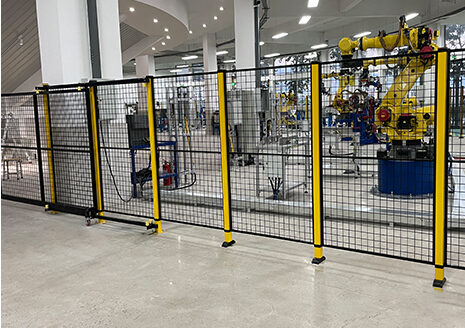
(Machine Guarding Fence Project Rendering )
Project Background & On-Site Safety Hazards
This project is a medium-sized automated precision parts processing factory with a production area of 15,000 square meters. The workshop is equipped with dozens of automated stamping machines, CNC processing equipment, robotic handling arms and continuous assembly lines. Before the renovation, the factory adopted traditional simple iron railings and plastic warning belts for equipment isolation. With the expansion of production scale and the improvement of industrial safety standards, the original protection mode exposed many obvious loopholes, restricting safe and standardized factory operation.
Unclear Equipment Zoning Causes Cross-Operation Risks
The original temporary isolation facilities have irregular heights and messy layouts. There is no clear physical boundary between manual operation areas and automatic equipment working areas. Staff often accidentally step into high-speed operating zones during material handling and patrol inspection. Cross-operation between personnel and equipment greatly increases the probability of mechanical collision and clamping accidents.
Low-Strength Barriers Cannot Resist Equipment Vibration & Impact
Traditional simple guardrails have thin pipe walls and unstable structures. Long-term equipment operation vibration causes loose bolts and overall tilting. Temporary warning belts are easily damaged and displaced by cargo friction and personnel contact, unable to form long-term stable physical isolation barriers. The protection failure frequently occurs during peak production periods.
Non-Standard Spacing Leads to Potential Safety Hazards
The mesh and gap spacing of ordinary isolation facilities do not comply with OSHA industrial safety standards. Excessive gaps may cause workers’ hands and arms to stretch into the equipment operating area by mistake, while too dense structures affect daily equipment observation and lighting. Unstandardized spacing design becomes a key hidden danger for safety audits and on-site accident prevention.
Inconvenient Maintenance Affects Production Efficiency
The original fixed welded isolation structure has no reserved flexible access. When equipment fails, needs regular maintenance or tool replacement, workers need to disassemble the barriers forcibly, resulting in long maintenance time and serious production shutdown losses. It cannot balance safety protection and operational flexibility.
BDINDUSTRIAL Custom Machine Guarding Fence Solution
Combined with the factory’s automated equipment layout, personnel operation routes and safety audit standards, the BDINDUSTRIAL engineering team abandoned the traditional simple isolation mode. We customized full-standard modular machine guarding fence systems, adopting high-strength steel structure, standardized anti-climb mesh, flexible safety door configuration and anti-corrosion surface treatment. The solution completely solves on-site safety loopholes, realizes standardized equipment zoning, and meets long-term safe production and audit requirements.
High-Strength Thickened Steel Structure for Anti-Impact Protection
Different from ordinary thin guardrails, BDINDUSTRIAL machine guarding fences adopt thickened square steel frames and reinforced mesh panels. The overall structural rigidity is high, which can resist accidental collision of handling trolleys, equipment vibration and daily personnel extrusion. It will not deform or loosen for a long time, maintaining stable physical isolation performance and effectively protecting high-speed operating mechanical areas.
OSHA Standard Mesh Spacing to Avoid Misoperation Risks
All fence mesh spacing and structural gaps are strictly designed in accordance with industrial safety specifications. The scientific gap size prevents staff’s limbs from stretching into the dangerous equipment area by mistake, while ensuring unobstructed on-site lighting and real-time observation of equipment operating status. It eliminates potential safety hazards caused by non-standard spacing and fully meets safety audit standards.
Flexible Safety Access Door Design for Convenient Maintenance
According to the equipment maintenance frequency and operation requirements, we reasonably configure single-opening and double-opening safety guard doors at key positions. The doors are equipped with anti-collision locks and silent hinges, which are easy to open and close. Daily equipment inspection, maintenance and tool replacement can be completed quickly without dismantling the fence, greatly reducing maintenance downtime and improving production continuity.
Modular Bolted Assembly for Flexible Layout
The whole machine guarding fence adopts standardized modular bolted assembly structure, without on-site welding and cutting. The installation speed is fast, and the layout can be adjusted arbitrarily according to equipment position and production line optimization. When the production line is upgraded and equipment is replaced in the later stage, the fence can be disassembled and reused, avoiding resource waste and reducing secondary procurement costs.
Dual Anti-Corrosion Treatment for Long-Term Stable Use
All fence frames and mesh panels undergo hot-dip galvanizing and electrostatic powder spraying dual anti-corrosion treatment. The smooth and wear-resistant surface resists industrial dust, oil fume and seasonal humidity erosion. It is not easy to rust, fade and peel, adapting to long-term high-frequency operation in industrial workshop environments and reducing daily maintenance pressure.
Post-Renovation Operation Effects & Project Advantages
After the completion of the BDINDUSTRIAL machine guarding fence safety renovation, the factory’s on-site safety management level has been fully upgraded. After one year of continuous operation, the workshop has achieved zero mechanical safety accidents, and the standardized zoning layout has passed multiple industrial safety audits at one time.
The clear physical isolation completely separates personnel walking areas from automated equipment operating areas, eliminating cross-operation safety risks. The high-strength stable structure adapts to long-term equipment vibration and on-site handling impact, with no deformation or loosening of any fence components. The flexible safety door design greatly improves equipment maintenance efficiency, reducing annual shutdown maintenance time by more than 70%.
In addition, the neat and unified fence layout standardizes the workshop production environment, realizes refined management of equipment zoning, and effectively improves the overall production order and safety awareness of employees. The reusable modular structure also reserves sufficient adjustment space for later production line upgrading, bringing long-term safety and economic benefits to the enterprise.
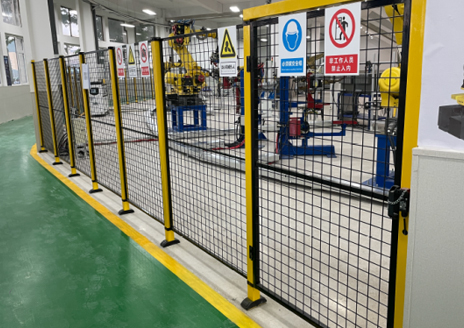
(Machine Guarding Fence Project Rendering)
Core Application Scenarios of BDINDUSTRIAL Machine Guarding Fence
Automated Production Lines & Robotic Workstations
Suitable for isolation of robotic arms, automated assembly lines and intelligent handling equipment to prevent accidental entry and collision and ensure stable operation of intelligent production equipment.
Stamping, Cutting & High-Speed Mechanical Zones
Protect high-risk mechanical equipment with rotating, stamping and cutting functions, block flying debris and accidental limb contact, and eliminate mechanical injury hazards.
Factory Safety Zoning & Personnel-Vehicle Separation
Standardize workshop functional divisions, separate equipment operation areas, material stacking areas and pedestrian passages, and standardize on-site production order.
Equipment Maintenance Isolation & Temporary Safety Protection
Used for temporary isolation during equipment overhaul and maintenance to avoid misoperation of surrounding personnel and ensure construction safety.
If you need OSHA-compliant, high-strength and flexible machine guarding fence customized solutions for factory safety renovation and new production line construction, contact BDINDUSTRIAL. We provide free on-site safety assessment, personalized scheme design, global factory direct supply and full-cycle after-sales technical support.
FAQ
1. What is the difference between machine guarding fence and ordinary warehouse isolation fence?
Machine guarding fences are specially customized for industrial high-risk equipment protection, complying with OSHA and ANSI industrial safety standards. They feature standardized anti-climb mesh spacing, higher structural impact resistance and flexible maintenance access design, focusing on preventing mechanical injury and accidental entry. Ordinary isolation fences only realize simple zoning functions, with low structural strength and non-standard spacing, unable to meet equipment safety protection and audit requirements.
2. Can modular machine guarding fence adapt to production line adjustment?
Yes. BDINDUSTRIAL machine guarding fences adopt full modular bolted assembly structure, which can be disassembled, adjusted and reassembled at will. When the factory optimizes production lines, replaces equipment and adjusts functional zoning, the fence can be reused without overall scrapping. It has extremely high flexibility and effectively saves long-term renovation costs.
3. Does machine guarding fence affect daily equipment maintenance and observation?
No. We scientifically configure transparent and breathable mesh structure and reserved safety access doors according to on-site conditions. The open mesh design does not block equipment observation, lighting and ventilation. The reserved access doors allow quick entry for maintenance and inspection, perfectly balancing safety isolation and operational convenience without affecting normal production and maintenance work.
4. How long is the service life of industrial machine guarding fence?
With BDINDUSTRIAL’s dual hot-dip galvanizing and powder coating anti-corrosion process and high-strength steel structure, the machine guarding fence can maintain stable performance for more than 12 years in conventional factory environments. It resists vibration, impact, dust and humidity erosion, with no frequent rust, deformation and damage, and low daily maintenance cost.
5. Can BDINDUSTRIAL provide personalized customized machine guarding solutions?
Absolutely yes. According to different equipment types, risk levels, workshop layouts and safety audit standards, we can customize fence height, mesh density, access door position and structural strength. Our team provides one-stop services from on-site survey, scheme design, production and installation to ensure the solution fully matches on-site safety protection needs.