


BDINDUSTRIAL recently completed a machine guarding fence project for a metal stamping and robotic welding plant that was under pressure from its insurance auditor. The factory ran six robotic welding stations and four heavy presses side by side, and the old guarding setup, a mix of worn mesh panels and painted floor lines, no longer convinced anyone responsible for safety. Workers could still reach into machine danger zones through gaps, and the safety manager wanted a guarding solution built to documented safety distances, not guesswork. BDINDUSTRIAL was brought in to design, supply and supervise the installation of a complete machine guarding fence system around every hazardous work cell.
Project Background & Client Challenges
The plant covers roughly 8,000 square meters and runs two shifts. Each robotic welding cell operates with live tooling movements, and the presses cycle automatically. The client listed four specific problems before we started.
Gaps and loose panels around old machine guarding
The previous fence had been patched over years, leaving uneven panel joints and bent corners. Maintenance staff sometimes propped panels open for quick access and forgot to close them. These gaps exposed operators and passers-by to moving machine parts.
No verified safety distances for reach protection
No one on site had calculated reach distances between the fence and the moving parts. Some panels sat too far from the hazard, letting arms reach over or around the guarding. The insurance auditor flagged this as a non-conformity that had to be fixed before renewal.
Interlock gates missing on robot cells
The robotic welding cells used ordinary hook latches. When a worker opened a gate, the robot kept moving until someone manually pressed a stop button. The plant needed interlock-ready gates wired into the robot safety circuit.
Downtime pressure during installation
The plant could not stop production for a full shutdown. Any guarding upgrade had to be installed zone by zone, with machines back online within hours, which ruled out slow on-site fabrication work.
BDINDUSTRIAL Custom Machine Guarding Solution
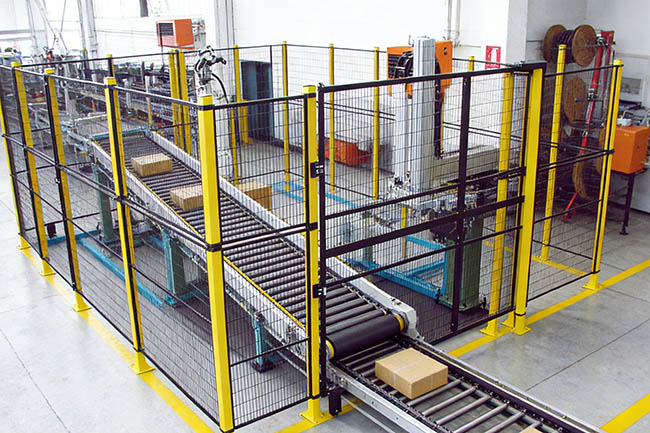
Our engineers measured every cell, mapped the machine danger zones and calculated safety distances according to reach standards before ordering materials. The full package covered guarding panels, posts, interlock gates and warning signage.
Welded mesh panels sized to reach distance requirements
We selected 20×100 mm welded mesh panels with 3 mm wire for all robot cells, a mesh size that stops hand and finger penetration while keeping clear visibility for operators. Panel heights were set at 1400 mm and positioned at a standoff distance calculated from the machine danger zone, so reaching over the top is physically blocked.
Heavy-duty posts and floor anchoring
Each panel run uses 60×60 mm steel posts welded to base plates and bolted into the concrete floor. The anchoring was load-tested at key corners, because the plant wanted the fence to stay upright even if a forklift or pallet truck grazes it during busy shifts.
Interlock gates wired into the safety circuit
Every robot cell got a hinged access gate with a safety interlock switch housing. The switch wiring was connected to the robot controller, so the robot enters a safe stop state the moment the gate opens. Maintenance staff regain access only after the cell is confirmed safe.
Standardized warning labels and zone marking
We fitted laminated warning labels at each gate and along panel runs, in line with common machine guarding marking practices. Zone paint on the floor now matches the fence lines, so temporary workers understand the boundary even before training.
On-site Installation & Execution
Installation was planned zone by zone to keep production running. Each work cell was isolated, guarded and handed back within one shift.
Prefabricated panels cut installation time
All panels and gates were fully fabricated and finished in BDINDUSTRIAL’s factory. The site crew only anchored posts and bolted panels into place, so no welding or painting was needed inside the workshop. The entire guarding system, about 210 running meters across ten cells, was installed in six working days.
Safety distance verification on site
After assembly, our team re-measured the distance between each fence line and the machine danger zone, and confirmed the mesh opening size against the reach standard. The measurements were logged and handed to the safety manager as part of the audit evidence pack.
Project Results After Handover
Three months after completion, the plant’s safety manager shared the numbers during a routine review. The guarding system passed the insurance audit on the first re-inspection, and the interlock gates are now treated as a fixed part of the robot startup sequence.
Fewer near-misses around machine cells
Incidents involving accidental entry into robot or press zones dropped noticeably. The combination of physical barriers, interlock gates and clear markings removed the main paths people used to reach into danger areas.
Cleaner audit record and faster inspection
Because every safety distance and mesh size is documented, the external auditor could verify compliance quickly instead of measuring panels on the spot. The plant now reuses the same evidence pack for internal quarterly checks.
Where Machine Guarding Fence Fits Best
Machine guarding fence is not a one-style product. The right mesh, height and gate setup depends on the machine and the risk.
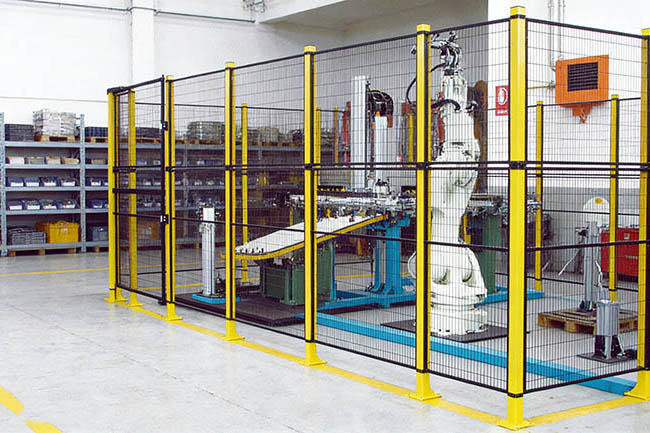
Robotic welding, assembly and palletizing cells
Any automated cell with moving arms or rotating tooling benefits from mesh guarding with interlock gates. Visibility matters here, so operators can watch cycle status without opening the cell.
Presses, CNC machines and conveyors
For presses and CNC equipment, a heavier frame and carefully positioned mesh keeps operators out of pinch and crush zones while allowing chip and coolant to pass through for cleaning.
If your plant needs machine guarding fence designed to real safety distances, with interlock gates and audit-ready documentation, contact BDINDUSTRIAL. We can survey your machines, calculate reach distances and supply a guarding layout that keeps production running while protecting your people.
FAQ
What mesh size should a machine guarding fence use?
For most robot and machine guarding, 20×100 mm mesh with at least 3 mm wire is the common choice because it stops fingers and hands from reaching through while keeping good visibility. The exact size still depends on the distance between the fence and the machine danger zone, so always verify it against the reach distance standard.
Does a machine guarding fence need interlock gates?
For automated equipment such as robots, presses and CNC machines, interlock gates are strongly recommended. The gate switch pauses the machine when opened, preventing a worker from entering a live cell. Simple hook latches are not enough for zones with automatic cycles.
Can machine guarding fence panels be relocated when production lines change?
Yes, if the system uses bolted posts and base plates. You can unbolt the panels, move the posts and reinstall them in a new layout. Fully welded fixed structures are harder to move, so choose bolted modular construction when layout changes are likely.
What is the difference between machine guarding fence and warehouse guarding fence?
Machine guarding fence is engineered around reach distances and interlock requirements for automated equipment, so mesh size, height and gate design follow machine safety standards. Warehouse guarding fence is mainly for separating forklift and pedestrian traffic and securing storage zones, with less emphasis on interlock control.
Does BDINDUSTRIAL provide documentation for safety audits?
Yes. For machine guarding projects we provide drawings, mesh specifications, safety distance measurement records and installation evidence, which helps your site pass external audits and internal compliance checks.