


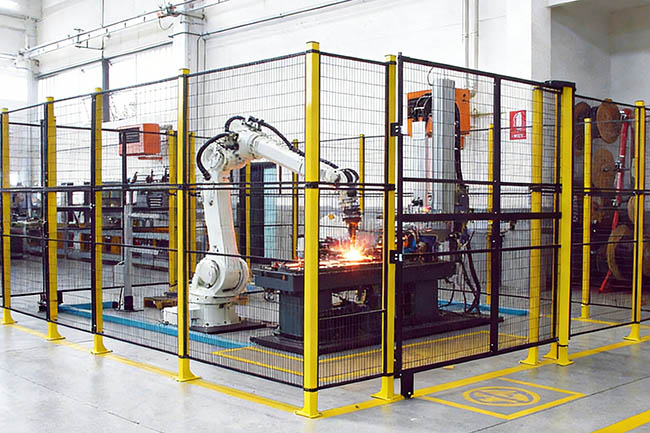
Automated robotic cells have become the core of modern smart manufacturing, widely used in automotive welding, product assembly, laser cutting and automated sorting workshops worldwide. While industrial robots greatly boost production efficiency, high-speed mechanical operation, large working radius and sudden robotic arm movement also bring unique on-site safety risks. Many manufacturing plants and automation integrators make a common mistake: using ordinary workshop isolation fences to replace professional robot safety fences. These generic barriers feature oversized mesh, weak structural rigidity and non-standard height design, failing to meet international safety specifications and leaving persistent safety hazards.
Unprofessional robot guarding solutions easily cause accidental personnel intrusion, mechanical collision accidents and frequent safety switch misalignment, leading to unplanned production downtime and failed safety audits. In severe cases, unstandardized fencing will directly delay project acceptance and increase long-term operational risks. BDINDUSTRIAL is a professional global supplier of customized robot safety fence systems. We focus on ISO-standard robot cell guarding design and production, serving automated manufacturing projects in Europe, Southeast Asia, the Middle East and North America. Our robot-specific safety fences perfectly balance safety compliance, space utilization and maintenance convenience for high-speed robotic working scenarios.
Key Safety & Operational Pain Points Solved by Professional Robot Safety Fence
Non-Standard Mesh Causes Audit Failure & Space Waste
Most ordinary industrial fences adopt large 50x50mm mesh holes. According to ISO 13857 international robot safety standards, oversized mesh requires a larger safety distance between the fence and robotic equipment to prevent finger or arm intrusion. This forces factories to reserve extra idle space, seriously wasting valuable workshop floor area, especially for compact retrofitted production lines. In addition, non-standard mesh spacing cannot pass local industrial safety audits, resulting in mandatory project rectification and cost loss.
Ordinary Fence Deformation Triggers Frequent Production Shutdowns
Industrial robots work continuously at high frequency, generating persistent vibration and occasional arm impact. Ordinary light-duty mesh fences lack reinforced frames and rigid structures. Long-term vibration causes mesh sagging, loose brackets and overall deformation. Once the fence deviates from the original position, it will trigger safety interlock switch misalignment, leading to frequent PLC emergency shutdowns. Repeated startup and shutdown not only reduces production efficiency but also accelerates equipment loss.
Unregulated Isolation Leads to Personnel Safety Accidents
Robot working cells belong to high-risk closed operation areas. During equipment debugging, mold replacement and daily patrol inspection, workers may accidentally enter the robot operating radius without effective physical isolation. Generic fences have insufficient height and poor anti-climbing performance, unable to block unauthorized entry. High-speed robotic arm operation can easily cause clamping, collision and extrusion injuries, bringing major safety risks to workshop personnel.
Poor Maintenance Access Affects Equipment Iteration Efficiency
Many traditional robot isolation schemes adopt fixed welding structures or unreasonable door position design. When robots need regular maintenance, program upgrading and fault troubleshooting, maintenance workers have to disassemble large areas of fences or apply for hot work permits for on-site cutting. This consumes a lot of time and labor, delays maintenance progress and restricts flexible production line iteration and layout adjustment.
Core Advantages of BDINDUSTRIAL Robot Safety Fence
Full Compliance with Global ISO Safety Standards
All BDINDUSTRIAL robot safety fences are designed strictly in accordance with ISO 13857 and ISO 14120 machine guarding standards. We adopt finger-safe standardized mesh spacing and scientific isolation height, which effectively prevent personnel intrusion without requiring excessive reserved safety distance. This design greatly improves workshop space utilization while ensuring full compliance, helping global manufacturing enterprises pass safety inspections and project acceptance smoothly without secondary rectification.
Reinforced Rigid Structure Anti-Vibration & Anti-Impact
Different from ordinary light-duty fences, our robot safety fences adopt thickened square tube reinforced frames and high-tensile welded mesh integration technology. The overall structure features strong rigidity, uniform stress and excellent stability. It can resist long-term robot vibration, instantaneous robotic arm collision and occasional AGV scraping without deformation or loosening. The stable structural performance completely avoids false shutdown faults caused by fence displacement, ensuring continuous and stable operation of automated production lines.
Modular Pre-Engineered Design for Fast Installation
Our robot safety fence systems adopt full modular bolt assembly structure, with pre-reserved safety interlock switch mounting positions and standard maintenance door interfaces. No on-site welding, cutting and drilling construction is required. Overseas engineering teams can complete assembly and commissioning quickly with conventional tools, greatly shortening project cycle. The detachable structure supports free disassembly and rearrangement, adapting to production line upgrading, robot replacement and workshop layout adjustment.
Diversified Surface Treatment for Global Complex Environments
To adapt to different global workshop environments, we provide two mature surface treatment processes. Electrostatic powder coating is anti-UV, wear-resistant and anti-spatter, suitable for robot welding cells and indoor high-standard automated workshops. Hot-dip galvanizing process offers excellent salt spray and corrosion resistance, perfectly adapting to coastal humid factories and open automated production zones. It effectively avoids rust, aging and paint peeling, ensuring long-term stable service life of the fence.
Customized Solutions for Complex Robot Cell Layouts
We support full non-standard customization for special robot working radii, compact workshop spaces and multi-robot intensive layouts. According to on-site equipment distribution and production process requirements, we can adjust fence height, mesh density, panel size and door types. We also customize special-shaped elbows, transition accessories and narrow-space isolation components to solve the guarding difficulties of irregular robot cells, realizing fully fitted safety protection.
Main Application Scenarios of Robot Safety Fence
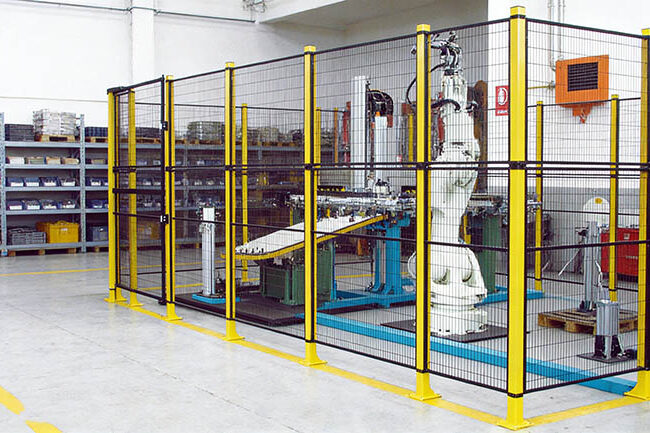
BDINDUSTRIAL standardized and customized robot safety fences are widely used in various global automated manufacturing scenarios, including automotive robot welding cells, industrial robot assembly stations, laser cutting robot isolation zones, intelligent handling robot cells, multi-robot intensive working areas and automated production line safety partitioning. Our reliable guarding performance helps global factories standardize robot zone management and eliminate operational safety hazards.
If you need ISO-compliant, anti-vibration and easy-maintenance robot safety fences for automated workshop construction and robot cell renovation projects worldwide, contact BDINDUSTRIAL. We provide free professional safety scheme design, personalized customization, factory direct prices and full-cycle cross-border after-sales technical support.
FAQ
1. Why can’t ordinary industrial fences replace professional robot safety fences?
Ordinary industrial fences lack targeted design for robot working scenarios. They have oversized non-standard mesh, insufficient structural rigidity and poor vibration resistance. Long-term robot operation vibration easily causes deformation and displacement, triggering safety switch faults and downtime. Meanwhile, they fail to meet ISO robot safety standards, cannot pass international safety audits and have major safety loopholes, which are not suitable for high-risk automated robot cells.
2. Can BDINDUSTRIAL robot safety fences connect with safety interlock systems?
Yes. All our robot safety fences are pre-engineered with standard mounting positions for safety interlocks, access sensors and PLC linkage devices. No secondary drilling or modification is required on site. It can seamlessly dock with mainstream robot control systems, realizing automatic power-off and shutdown protection when personnel open the safety door, greatly improving the intelligent safety level of robot cells.
3. Do your robot safety fences meet international industrial safety standards?
Absolutely. Our products are fully compliant with ISO 13857 and ISO 14120 international machine guarding standards. The mesh spacing, isolation height, structural impact resistance and anti-climbing performance all meet the safety audit requirements of Europe, Southeast Asia, the Middle East and other global regions. We can provide complete qualification test reports to support project acceptance.
4. Is modular robot safety fence convenient for later equipment maintenance?
Very convenient. Different from fixed welded fences, our modular bolt assembly structure allows quick disassembly of local fence panels and safety doors. Maintenance personnel can easily enter the robot working area for fault checking, component replacement and program upgrading without large-scale demolition. The reusable structure also saves renovation costs for later production line adjustment.
5. Can you customize solutions for compact robot cells with limited space?
Yes. We have rich experience in space-limited robot cell customization. Our engineering team optimizes mesh specifications and safety distance design according to narrow workshop conditions, effectively saving floor space. We also design narrow-size panels and special transition accessories to adapt to intensive multi-robot layouts, ensuring safety compliance while maximizing workshop space utilization.