


Industrial automation is reshaping factory production across the globe. Robotic welding, palletizing, assembly and handling equipment greatly boost output and precision, yet they bring unavoidable on-site safety risks. High-speed robotic arms operate within fixed working radii. Without standardized isolation barriers, staff misoperation, accidental entry and equipment collision accidents happen frequently.
Many factory operators make a common mistake. They install ordinary mesh fences for robotic cell isolation, only to face various problems in actual use. Ordinary barriers shake easily under long-term mechanical vibration, fail to block welding sparks and arc light, and cannot match safety interlock devices. Worse still, most generic fences cannot pass international safety audits, forcing production line shutdowns and repeated renovations.
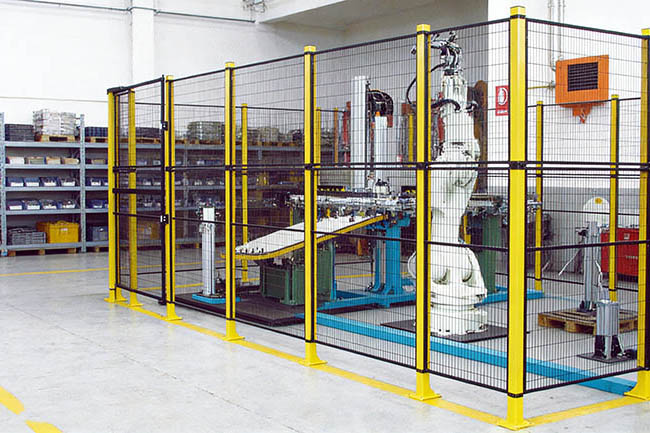
Professional robot safety fences are different. Customized for automated working cells, they feature anti-vibration structure, impact resistance and safety standard compliance. BDINDUSTRIAL is a global manufacturer focusing on industrial robot safety guarding. We have delivered thousands of customized robot fence projects for automated factories in Europe, Southeast Asia, the Middle East and other regions. The following real project cases show our practical solutions for different robotic working scenarios.
Common Pain Points of Traditional Robot Isolation Fences
Weak Structure Cannot Resist Long-Term Vibration & Impact
Ordinary assembled fences rely on simple bolt splicing. Long-term high-frequency operation of robotic equipment generates continuous vibration. Over time, the frame loosens, mesh deforms and connecting parts fall off. When forklifts pass nearby or goods accidentally collide with the fence, the whole isolation system will shift, losing basic protection ability.
Single Structure Fails to Meet Diversified Robot Working Needs
Different types of robotic cells have unique hazard characteristics. Welding robots produce strong arc light and high-temperature sparks. Palletizing robots have large working radii and heavy-load movement. Polishing robots generate a lot of dust. Ordinary single mesh fences cannot block arc light, isolate dust or prevent splashing, resulting in incomplete on-site safety protection.
Non-Standard Design Fails Global Safety Audit Standards
International automated factories have strict requirements on robot safety isolation. Fence height, mesh aperture, anti-climb performance and safety door design all have clear standard rules. Traditional civilian-grade fences have irregular sizes and unreasonable structures. They cannot match local industrial safety specifications, easily leading to audit failure and affecting factory normal operation.
BDINDUSTRIAL Global Robot Safety Fence Real Project Cases
Automotive Welding Robot Cell Anti-Arc Safety Isolation Project
An auto parts manufacturing plant in Southeast Asia upgraded its automated welding production line. Multiple six-axis welding robots work continuously in the workshop. The original common mesh fences could not block intense welding arc light and flying sparks. Arc radiation caused visual fatigue for nearby operators, and scattered sparks brought potential fire hazards. The factory needed compliant safety fences with arc light shielding and splash prevention functions.
BDINDUSTRIAL customized composite robot safety fences for this project. We adopted high-transparent anti-arc panels combined with heavy-duty steel frames. The panels effectively isolate ultraviolet radiation and high-temperature sparks, stopping light pollution and splash diffusion completely. The reinforced integral welding frame resists long-term equipment vibration without loosening or shaking. We reserved installation positions for safety interlock switches and emergency stop devices to match automated linkage systems. After installation, the workshop passed the local industrial safety audit smoothly, and the on-site working environment was greatly optimized.
Logistics Palletizing Robot Heavy-Duty Anti-Collision Fence Project
A large European logistics warehouse introduced multiple heavy-load palletizing robots for intelligent cargo sorting and stacking. The robotic working area covers a wide range. Forklifts and handling trolleys pass frequently around the cell. The original thin isolation fences were often scratched and deformed by vehicles, unable to bear occasional heavy impact. The customer required ultra-stable, high anti-collision robot safety barriers.
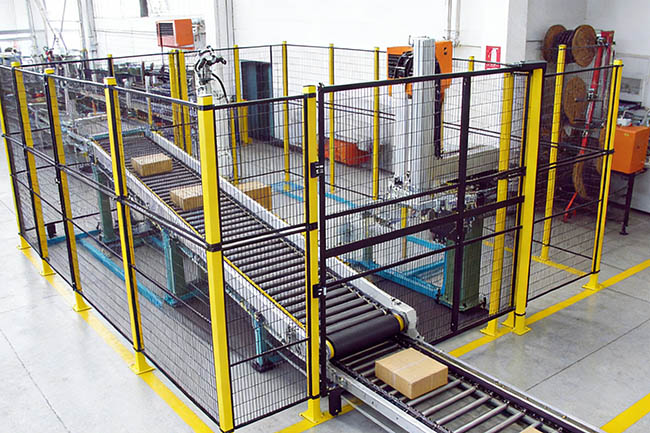
For this heavy-duty working scenario, we configured thickened full-welded robot safety fences. The square tube frame and reinforced mesh structure greatly improve overall impact resistance, able to withstand daily forklift scraping and cargo collision. We adopted heightened fence design according to the robot working radius to prevent equipment overrange movement and personnel crossing. The modular sliding safety door saves aisle space and facilitates daily equipment maintenance and staff entry and exit. After project delivery, the isolation system operates stably all year round, with no deformation or damage, perfectly adapting to high-frequency logistics operation scenarios.
Mechanical Processing Robot Dust-Proof Isolation Renovation Project
A mechanical processing factory in the Middle East has batch processing robotic cells. Cutting and polishing work produces a large amount of metal dust and debris. The original open mesh fences could not limit dust diffusion, causing equipment aging and environmental pollution. The factory hoped to achieve dust isolation, perspective observation and safety protection at the same time.
BDINDUSTRIAL adopted perforated plate type robot safety fences for this renovation project. The dense micropore structure blocks metal debris and dust diffusion while maintaining good air permeability and sightline. Managers can clearly observe the internal robot operation status without entering the working area. The overall electrostatic anti-rust coating adapts to dusty and dry industrial environments, resisting corrosion and dust accumulation. The standardized modular structure is convenient for later workshop layout adjustment and production line upgrading, bringing long-term stable safety protection for the factory.
Core Advantages of BDINDUSTRIAL Robot Safety Fence
Industrial-Grade Vibration & Impact Resistant Structure
Different from ordinary assembled fences, our robot safety fences adopt thickened steel frame and full welding reinforcement process. The overall structure has high rigidity and toughness. It can adapt to 24-hour continuous vibration of automated equipment and resist daily vehicle collision and personnel impact. No loosening, shaking or deformation occurs during long-term operation, ensuring stable isolation effect.
Multi-Type Panel Matching for Full-Scenario Adaptation
We support diversified panel collocation according to robot working types. Transparent anti-arc panels for welding robot cells, perforated dust-proof panels for polishing processing areas, and heavy-duty mesh panels for palletizing handling cells. Flexible material matching solves different safety hazards such as arc light radiation, dust pollution and splash damage, achieving targeted protection.
Fully Compliant with Global Industrial Safety Standards
All our robot safety fences are designed in accordance with international industrial safety specifications. Fence height, mesh aperture, anti-climb structure and safety door settings meet the audit standards of Europe, Southeast Asia, the Middle East and other regions. Reserved interfaces for safety interlock switches, light curtains and alarm devices realize intelligent linkage protection, helping factories pass safety inspections efficiently.
Modular Design for Flexible Layout Adjustment
Adopting international unified modular design, all fence panels, columns and safety doors are highly compatible. The bolt assembly method requires no on-site welding, shortening construction cycle and reducing labor costs. The detachable structure supports free disassembly, movement and recombination. When the automated production line is upgraded or the workshop layout is adjusted, the fence can be reused flexibly to avoid repeated investment.
Low Maintenance & Long Service Life
All products undergo strict anti-corrosion treatment such as electrostatic powder coating or hot-dip galvanizing. The smooth surface resists dust accumulation and is easy to clean daily. It can adapt to high temperature, humidity, dust and other complex industrial environments worldwide. The stable structure and excellent anti-aging performance greatly reduce later maintenance frequency and replacement cost.
If you are looking for standard-compliant, impact-resistant and low-maintenance robot safety fences for your automated workshop renovation or new robotic cell project, contact BDINDUSTRIAL. We provide free on-site layout planning, personalized safety scheme design, factory direct price and full-cycle overseas after-sales technical support.
FAQ
1. What makes BDINDUSTRIAL robot safety fence different from ordinary isolation fence?
Ordinary fences only achieve simple visual isolation with poor vibration resistance and no standard compliance. BDINDUSTRIAL professional robot safety fences are tailor-made for automated working cells. They have anti-vibration and anti-collision industrial structure, multi-functional panel options for arc light, dust and splash protection, and fully comply with global industrial safety audit standards, which is more suitable for long-term stable operation of robotic production lines.
2. What robotic working scenarios are your safety fences suitable for?
Our robot safety fences adapt to almost all industrial automated scenarios, including welding robot cells, palletizing and handling robot areas, cutting and polishing processing robots, intelligent assembly robotic lines and other automated equipment zones. It can meet the safety isolation needs of various factory automation upgrades worldwide.
3. Can you customize robot safety fences for special workshop layouts?
Yes. We support full global non-standard customization. According to your actual workshop space, robot working radius, hazard types and local safety standards, we can adjust fence height, mesh density, panel type and safety door style. Custom special-shaped structures and intelligent accessory matching schemes are also available to solve various irregular site layout problems.
4. Are your robot safety fences compliant with international safety standards?
Absolutely. Our products follow international industrial safety design specifications, covering fence safety height, anti-climb aperture, structural impact resistance and linkage device compatibility. They can pass safety audits in Europe, Southeast Asia, the Middle East and most global regions, fully meeting the standardized safety management requirements of automated factories.
5. Is the installation and later adjustment of robot safety fence convenient?
Very convenient. All products adopt prefabricated modular design, with on-site bolt assembly and no secondary welding or cutting. The construction speed is fast. The detachable and reusable structure supports free disassembly and layout adjustment. When the production line is updated or the functional area is adjusted, the fence can be rearranged and reused to save project costs.