


For warehouse managers, facility engineers and procurement teams, budgeting for industrial safety infrastructure requires clarity and accuracy. Warehouse guarding fences are essential for zoning work areas, protecting staff, isolating machinery, and securing inventory. However, pricing varies drastically across suppliers, project scales and product grades. Many buyers face budget overruns after only focusing on upfront unit prices while ignoring hidden costs and mismatched selections.
Understanding the core factors that drive warehouse guarding fence costs helps teams make cost-effective, long-term decisions, avoid overpaying for unnecessary features or purchasing low-quality products that trigger frequent replacements. Beyond basic pricing breakdowns, this guide from BDINDUSTRIAL also shares practical selection strategies to balance initial investment and total lifecycle value for all warehouse safety projects.

Raw Material Grade and Structural Specifications
Material quality is the most fundamental factor determining warehouse guarding fence pricing. Industrial-grade safety fences rely on steel raw materials and structural thickness to deliver impact resistance and durability. Different material standards create obvious price gaps and completely different service life performance.
Steel Wire Diameter and Panel Thickness
Thicker steel wires and reinforced panel frames significantly improve structural stability and anti-impact performance. Light-duty thin-gauge fences cost less upfront but deform easily under forklift collisions and daily friction. Heavy-duty industrial fences with thickened steel materials bear higher raw material costs, yet they resist long-term vibration and extrusion without deformation. For high-traffic warehouse zones, thickened specifications are more cost-effective in the long run.
Base Material Type Differences
Most warehouse fences adopt low-carbon steel as the base material, but material purity varies greatly between manufacturers. High-purity industrial steel with stable tensile strength delivers consistent structural performance, while recycled steel contains impurities that weaken toughness and corrosion resistance. Although recycled material products are cheaper, they are prone to rust, breakage and structural failure within a few years.
Frame and Welding Standard
Reinforced full-welded frames and seamless corner treatments increase production costs but greatly enhance overall fence rigidity. Low-cost products often save costs by reducing welding points and simplifying frame structures, resulting in loose connections and weak impact resistance, which cannot meet industrial safety standards.
Surface Treatment and Anti-Corrosion Technology
Surface anti-corrosion treatment directly determines the service life and daily maintenance cost of warehouse guarding fences, becoming a key pricing factor easily ignored by buyers. Different coating processes form distinct price tiers and lifecycle performance gaps.
Basic Spray Painting Treatment
Ordinary single-layer spray painting is the most economical surface process, suitable for dry indoor warehouses with low environmental corrosion. The cost is low, but the coating fades and peels easily after 2 to 3 years, requiring regular repainting and maintenance, bringing continuous hidden expenses.
Hot-Dip Galvanizing Anti-Rust Process
Hot-dip galvanizing forms a thick and compact zinc layer on the steel surface, providing comprehensive anti-rust protection. This process costs more than ordinary painting but effectively resists humidity, dust and mild chemical corrosion. It can maintain stable performance for more than 10 years with zero daily maintenance, ideal for most standard industrial warehouses.
Dual Anti-Corrosion Composite Treatment
High-end warehouse fences adopt hot-dip galvanizing plus electrostatic powder spraying dual treatment. The double-layer protective structure achieves super weather resistance, adapting to coastal salt spray, humid workshops and outdoor open storage yards. This premium process has the highest unit cost but minimizes later replacement and maintenance costs, suitable for harsh working condition scenarios.
Design Style and Customization Requirements
Standard modular fence products have fixed sizes and unified mass production costs, while personalized customized designs will significantly change the overall project budget. Reasonable selection of standard or customized styles is crucial for cost control.
Standard Modular Fence Pricing
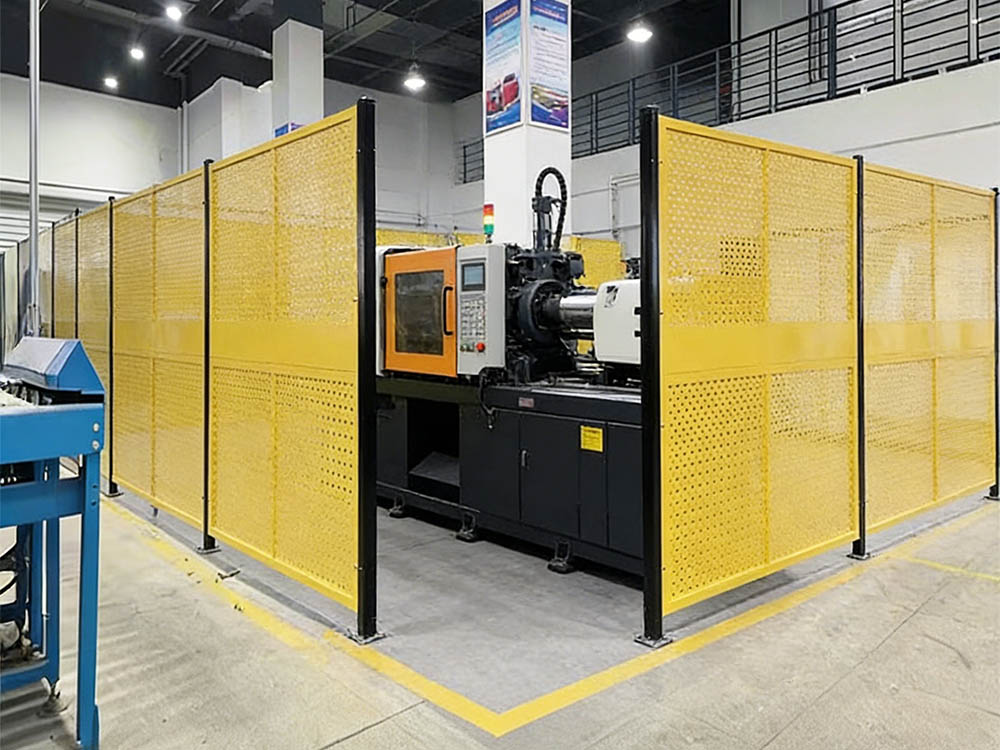
Mass-produced standard height, mesh spacing and color modular fences have mature production lines and lowest unit cost. They support arbitrary splicing and flexible layout adjustment, meeting most warehouse zoning, man-vehicle separation and machine isolation needs. Standard products are the first choice for budget-friendly conventional warehouse projects.
Personalized Customization Cost Increase
Special height adjustment, ultra-dense anti-climb mesh, special color matching, reserved equipment openings and special-shaped corner structures all require independent mold opening and personalized production, increasing processing and time costs. Customized projects are priced higher but can perfectly match complex warehouse layouts and special safety standard requirements.
Supporting Accessory Matching
Safety doors, warning signs, reinforced bases, anti-collision accessories and special fixing bolts also affect the total cost. Complete supporting accessories improve installation stability and safety performance, while simplified configurations reduce upfront investment but may cause loose installation and insufficient protection performance.
Project Scale and Installation Conditions
Total project volume and on-site construction conditions greatly affect the final comprehensive cost of warehouse guarding fence projects. Many buyers only calculate product prices while ignoring installation and site adaptation costs, resulting in budget deviations.
Bulk Order Volume Discounts
Large-scale warehouse renovation and new construction projects can enjoy obvious volume discounts. Bulk procurement reduces unit production and transportation costs, with the unit price decreasing significantly as the order quantity increases. Small-area sporadic renovation projects have relatively higher unit comprehensive costs due to fixed installation and transportation expenses.
On-Site Installation Environment
Flat indoor warehouse environments have low construction difficulty and low installation labor costs. Complex scenarios such as uneven ground, multi-beam obstacles, high-altitude laying and outdoor wind-prone environments require professional positioning, reinforcement and customized construction, increasing labor and time costs accordingly.
Transportation and Delivery Costs
Fence volume and weight, delivery distance and packaging standards all affect freight costs. Standard factory direct supply and centralized delivery can effectively control logistics expenses, while scattered small-batch orders generate higher average transportation costs.
Lifecycle Cost vs. Upfront Purchase Price
Professional procurement must focus on total cost of ownership (TCO) rather than one-time purchase price. Low-priced inferior products often bring higher long-term hidden costs, making high-quality industrial fences more cost-effective in the whole lifecycle.
Short-Term Replacement Cost of Low-Grade Fences
Cheap light-duty fences age rapidly, with frequent rusting, deformation and damage. They need overall replacement every 3 to 5 years, plus repeated maintenance and rectification costs, resulting in continuous capital investment. They also bring potential safety hazards and production shutdown losses caused by fence failure.
Long-Term Value of High-Quality Fence Systems
BDINDUSTRIAL high-standard warehouse guarding fences adopt thickened materials and dual anti-corrosion treatment, with a service life of more than 12 years. Zero daily maintenance and no frequent replacement effectively save long-term operational costs. Stable safety performance also avoids safety accident risks and audit failure losses, creating higher comprehensive value for enterprises.
If you need accurate budget quotation, cost-effective solution selection and professional warehouse fence layout design for your warehouse safety project, contact BDINDUSTRIAL. We provide free project evaluation, customized cost budgeting and factory-direct wholesale pricing to help you maximize investment value within your budget.
FAQ
1. What is the biggest factor affecting warehouse guarding fence cost?
Material thickness and anti-corrosion surface treatment are the core factors. Thickened industrial steel structures determine impact resistance and service life, while professional galvanizing and spraying processes prevent rust and aging. Low-cost products always cut corners on material thickness and coating technology, leading to short service life and high later replacement costs.
2. Are expensive custom warehouse fences always better than standard ones?
Not exactly. Standard modular fences have lower unit costs and stable quality, fully meeting most conventional warehouse zoning and safety isolation needs. Custom fences are only necessary for special sizes, complex layouts and special safety standards. Blind customization will cause budget waste, and professional matching according to actual scenarios is the most cost-effective choice.
3. Is it worth buying low-price warehouse guarding fences to save upfront budget?
Not recommended. Low-cost inferior fences have thin materials, poor welding and unqualified anti-corrosion treatment. They deform and rust in a short time, requiring frequent maintenance and overall replacement. The total lifecycle cost is much higher than high-quality products, and unstable protection performance will bring safety hazards and audit risks to the warehouse.
4. How to control warehouse fence project budget reasonably?
Prioritize standard modular products for conventional areas to reduce customization costs. Select targeted surface treatment according to the environment (choose galvanized process for humid areas and ordinary spraying for dry indoor areas). Control labor costs through bulk procurement and unified construction, and avoid over-designing high-end configurations for ordinary zoning scenarios.
5. Can BDINDUSTRIAL provide cost-effective customized fence solutions?
Yes. BDINDUSTRIAL’s professional team formulates targeted cost-matching solutions based on your warehouse environment, usage frequency, safety standards and budget. We avoid over-design and shoddy workmanship, balance upfront cost and long-term service life, and provide free quotation and layout optimization services to help customers save budget while ensuring safety quality.