


Most factory and logistics managers often confuse warehouse guarding fences with machine guarding fences, as both belong to industrial safety isolation barriers. In actual facility renovation and safety upgrading projects, mixing up these two fence types will lead to unreasonable zoning, unqualified safety protection and even failed compliance audits. Some teams blindly adopt machine guarding fences for warehouse perimeter isolation, resulting in excessive cost waste; others use ordinary warehouse fences to surround automated equipment, leaving serious mechanical injury hazards.
Although both safety fences adopt modular steel mesh structures, they differ greatly in core protection purposes, structural design, anti-risk performance and applicable scenarios. Clarifying the differences between warehouse guarding fence and machine guarding fence helps enterprises match accurate safety solutions, standardize factory layout and avoid safety risks and procurement losses. Based on years of industrial safety fence customization experience, BDINDUSTRIAL analyzes the essential differences, application standards and selection tips of the two fence types in detail.
Core Design Purpose: Site Zoning vs. Mechanical Risk Isolation
The fundamental difference between the two industrial fences lies in their original design goals. One focuses on overall site management and asset protection, while the other targets personal safety protection for high-risk mechanical operation areas.
Warehouse guarding fence: Focus on standardized site management
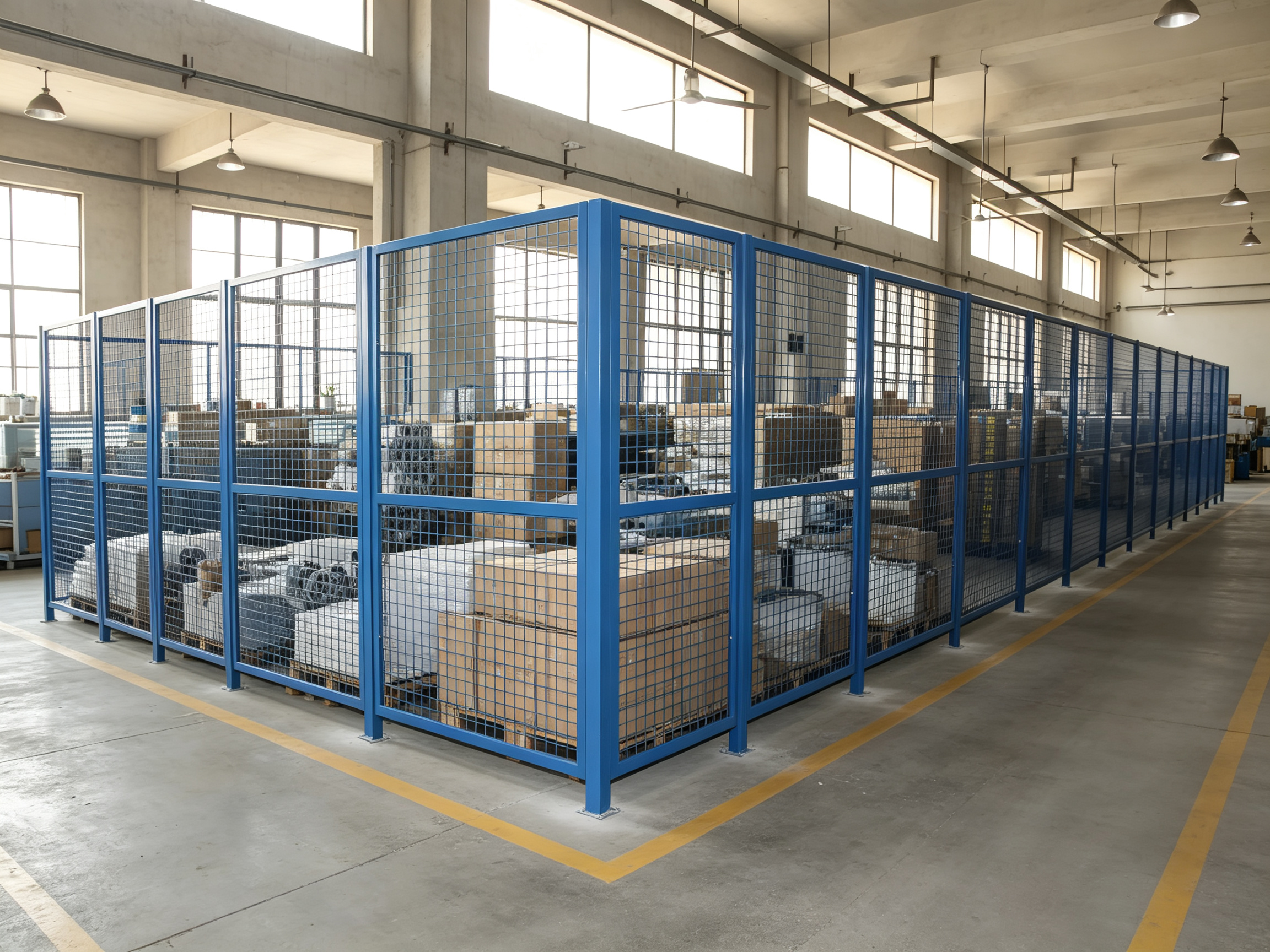
Warehouse guarding fences are designed for large-space storage parks and logistics warehouses. Its core goal is regional division, personnel access management and asset safety protection. It is mainly used to divide functional areas, isolate visitor passages, protect high-value stored goods and standardize the walking routes of personnel and vehicles. It solves management problems such as chaotic warehouse layout, random personnel entry and exit, and asset loss, with relatively mild daily risk scenarios.
Machine guarding fence: Focus on personal anti-injury safety protection
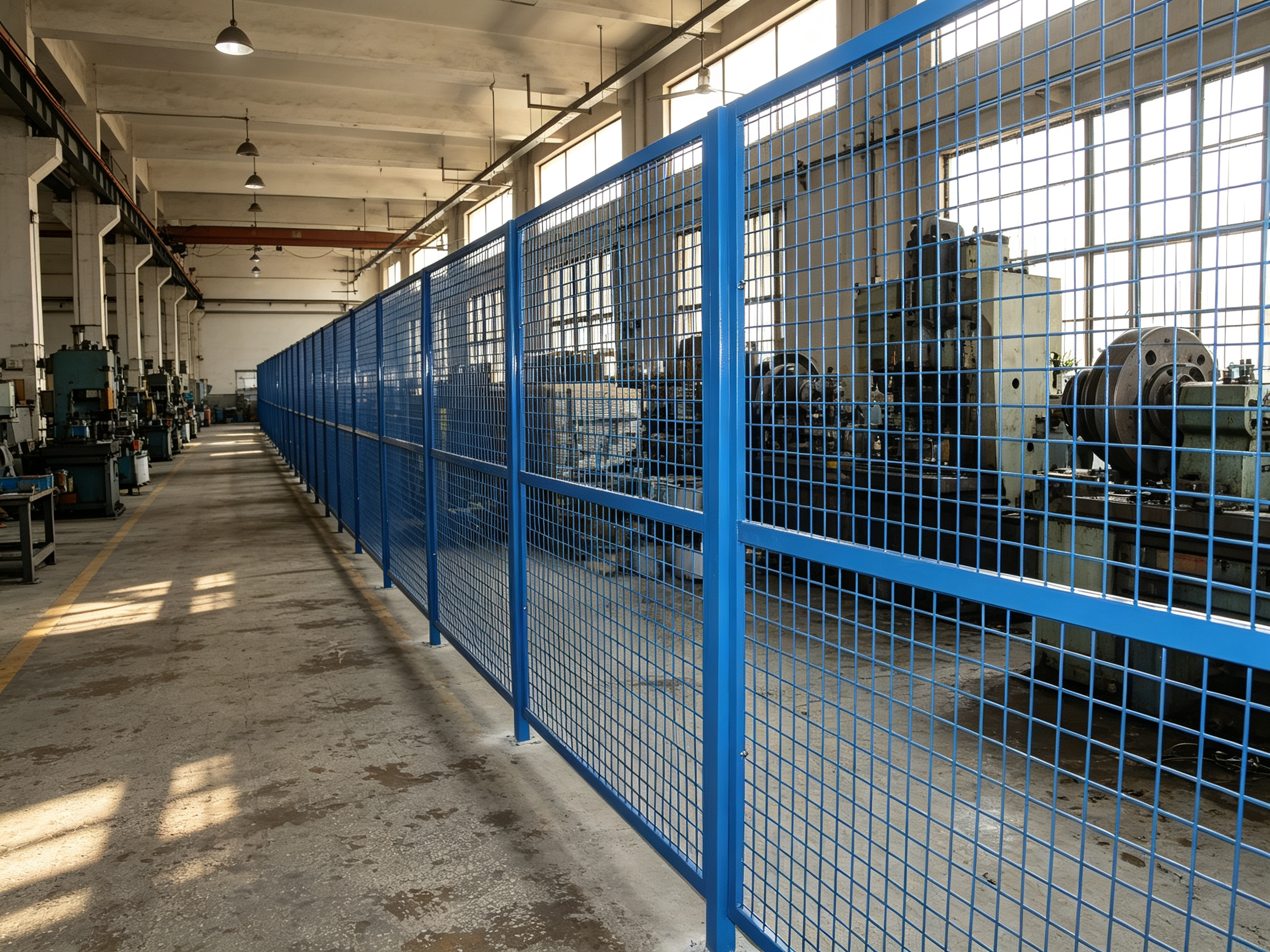
Machine guarding fences are professional safety barriers for automated production workshops and mechanical equipment stations. Its core purpose is to isolate high-risk moving machinery to prevent workers from accidental contact, climbing intrusion and hand stretching into equipment operating areas. It aims to eliminate mechanical extrusion, impact and splashing injury risks, directly facing high-frequency and high-risk industrial operation scenarios, and belongs to mandatory safety protection equipment for production lines.
Structural & Performance Differences Between Two Fence Types
Affected by different protection goals, BDINDUSTRIAL optimizes the structural strength, mesh standard, anti-intrusion performance and accessory configuration of the two fences in a targeted manner, forming obvious differences in industrial adaptability.
Mesh density & anti-penetration standard
Machine guarding fences adopt high-density micro-mesh design with small mesh spacing. This standard is formulated to prevent workers from stretching hands or tools into the rotating and moving range of robotic arms and stamping equipment, fully complying with OSHA mechanical safety specifications. Warehouse guarding fences adopt conventional dense mesh, which can meet anti-climb and anti-crossing needs, but the mesh spacing is slightly larger, focusing on overall isolation rather than precise anti-penetration protection.
Structural strength & impact resistance
Machine guarding fences use thickened square tube frames and fully welded reinforced structures. They can resist instantaneous impact of mechanical failure, equipment vibration and accidental collision of operating tools, and will not deform or loose for a long time. Warehouse guarding fences mainly resist slow-speed forklift collision and manual external force impact, with conventional industrial strength, meeting daily warehouse isolation and protection needs.
Safety door & linkage configuration
Machine guarding fences are usually equipped with safety interlock doors. The doors can be linked with equipment power supply system; the equipment will automatically stop running once the door is opened, avoiding misoperation injuries during maintenance. Warehouse guarding fences are equipped with ordinary mechanical lock doors, which only control personnel access and have no intelligent linkage function, focusing on access authority management.
Height specification design
Machine guarding fences have diversified height configurations according to equipment risk levels. High-risk robotic workstations adopt ultra-high fences to prevent climbing and crossing. Warehouse guarding fences mostly adopt unified conventional height, meeting perimeter isolation and regional zoning management of large warehouses.
Applicable Scenario Division & Selection Standards
Reasonable selection of safety fences must be based on on-site risk levels and functional needs. Blind universal use will lead to insufficient protection or cost redundancy.
Typical scenarios for warehouse guarding fences
Suitable for warehouse internal functional zoning, storage area perimeter protection, loading and unloading area isolation, factory passage division, visitor channel isolation and high-value material storage area protection. It is widely used in logistics warehouses, finished product storage depots and industrial park large-space zoning scenarios, focusing on site standardization and asset management.
Typical scenarios for machine guarding fences
Suitable for automated robot workstations, stamping and hydraulic equipment perimeter, high-speed conveyor lines, mechanical cutting areas and unmanned production line isolation. It is dedicated to all high-risk mechanical operation areas in manufacturing workshops, serving personnel safety production protection.
Common Selection Mistakes Enterprises Need to Avoid
In actual engineering procurement, many safety hidden dangers and cost waste come from incorrect fence matching. Summarizing common mistakes can help enterprises standardize safety facility configuration.
Using warehouse fences for mechanical high-risk areas
Ordinary warehouse fences have insufficient mesh density and structural rigidity, failing to prevent hand penetration and violent impact. Using them to isolate automated equipment will leave serious mechanical injury hidden dangers and cannot pass OSHA safety audits.
Blindly using machine fences for warehouse zoning
Machine guarding fences have higher material and process standards with higher unit price. Using high-standard machine fences for conventional warehouse zoning will cause unnecessary cost redundancy, greatly increasing the investment cost of warehouse safety transformation.
Ignoring scene differentiation and unified matching
A single factory usually has both warehouse storage areas and production mechanical areas. It is necessary to adopt differentiated matching schemes: machine fences for production high-risk areas and warehouse fences for storage zoning, realizing balanced safety and cost control.
How BDINDUSTRIAL Matches Customized Fence Solutions
BDINDUSTRIAL does not adopt unified standard configuration for all industrial sites. We conduct on-site risk assessment according to customer’s factory layout, equipment risk level and management needs, and accurately match warehouse guarding fences and machine guarding fences.
For logistics storage and large-space zoning projects, we deploy cost-effective warehouse guarding fence systems to ensure standardized site management and asset safety. For automated production lines and mechanical high-risk areas, we adopt OSHA-compliant machine guarding fences with anti-penetration, anti-impact and intelligent linkage functions to eliminate personnel safety hazards. All products adopt modular assembly structure, supporting free disassembly and layout adjustment, adapting to factory iterative upgrading.
If you are confused about fence selection for factory and warehouse safety renovation, or need differentiated customized safety fence schemes, contact BDINDUSTRIAL. Our professional safety engineering team provides free on-site risk assessment, accurate product selection and one-stop installation guidance to help you build compliant, safe and cost-effective industrial safety protection systems.
FAQ
1. Can warehouse guarding fences replace machine guarding fences for equipment isolation?
No. Warehouse guarding fences lack precise anti-penetration mesh design and high-strength anti-impact structure, and have no safety interlock protection function. They cannot prevent workers from accidental contact with moving machinery parts, failing to meet industrial mechanical safety standards. It is forbidden to replace machine guarding fences with warehouse fences in high-risk production areas.
2. What is the biggest difference between the two industrial safety fences?
The core difference lies in the protection orientation and safety level. Warehouse guarding fences focus on site zoning, personnel access management and asset protection for low-risk storage scenarios. Machine guarding fences focus on preventing mechanical injuries, with higher mesh precision, structural strength and safety linkage configuration, specially used for high-risk automated production scenarios.
3. Are machine guarding fences more expensive than warehouse guarding fences?
Yes. Machine guarding fences adopt thicker materials, denser mesh, reinforced welding process and supporting safety interlock accessories, with higher production process and safety standards, so the cost is higher. Warehouse guarding fences are more cost-effective for conventional site zoning and are suitable for large-area layout.
4. Do the two fences have the same installation and reuse performance?
They both adopt BDINDUSTRIAL modular bolt assembly structure, with no on-site welding and flexible disassembly and reuse. The difference is that machine guarding fences have higher installation precision requirements and need to be matched with equipment safety linkage systems, while warehouse fence installation is simpler and more suitable for rapid large-area layout.
5. Can one factory use both types of guarding fences at the same time?
Absolutely. A standardized industrial factory usually needs mixed configuration. Machine guarding fences are used for production line mechanical isolation to ensure personnel safety, while warehouse guarding fences are used for storage area zoning and passage management. Differentiated matching can maximize safety effect and control overall procurement cost.