


BDINDUSTRIAL took on this mixed-type industrial safety fencing project for a mid-sized manufacturing plant that runs automated assembly, grinding and packaging lines side by side. The customer’s old guarding setup used only welded mesh panels for every zone. While mesh worked well for robot perimeter guarding, fine metal dust and grinding sparks kept drifting out into pedestrian walkways and packing stations. The facility needed a hybrid solution: welded panels for zones requiring clear visibility, paired with perforated steel panels for areas that need debris containment. They contacted BDINDUSTRIAL to redesign the guarding layout, match local machine safety rules and keep production downtime low during installation.
Project Background & Client Pain Points
The factory occupies around 7,200 square meters, with robotic welding cells, grinding stations, conveyor lines and frequent forklift movement. The site safety team listed three main issues with their previous fencing.
Dust and spark spillage from grinding stations
Standard welded mesh has large open grids. Fine metal particles and stray sparks passed through the mesh, raising fire risks and making the packing area dirty. Cleaning cycles became longer and product contamination complaints started to rise.
Poor visibility balance across different work cells
If they switched everything to solid steel panels, supervisors and maintenance staff could not observe robot operation easily. They needed to see AGV paths and check whether operators followed lockout procedures. Full solid barriers would create blind spots.
Inflexible non-modular old barriers
The original fences were fixed welded frames. When the customer adjusted production lines every quarter, they had to cut and rebuild sections, which wasted time and extra budget.
Custom Solution Designed by BDINDUSTRIAL
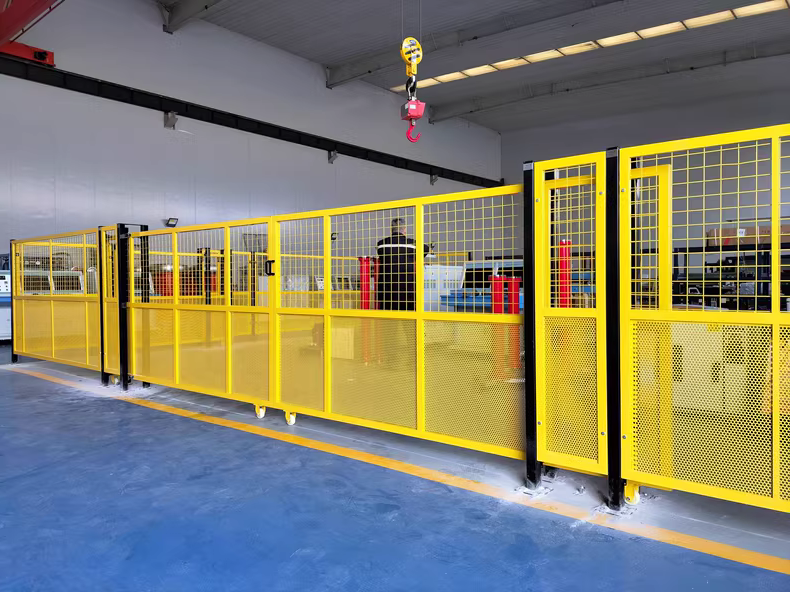
BDINDUSTRIAL’s engineering team visited the site, reviewed the risk assessment report and split the whole guarding system into two panel types for different zones. The solution combined welded mesh safety fence and perforated steel safety fence under one matching post and gate system.
Welded mesh panels for robot cells, AGV lanes and pedestrian separation
We selected 20×100 mm welded mesh panels with 3 mm steel wire for automated assembly zones and forklift walkway dividers. This design keeps high visibility for supervisors, allows good air circulation and blocks hands from reaching moving machinery. Operators can check robot status without opening safety gates frequently.
Perforated steel panels for grinding, polishing and dust-generating stations
Round-hole perforated steel sheets with 8 mm hole size were used around grinding and buffing cells. The small holes stop most flying debris and sparks while still letting natural light and air flow through. Unlike solid steel plates, perforated panels avoid heat buildup inside the enclosed work cell.
Unified modular frame and accessory set
All panels share the same heavy-duty Q235 posts, base plates and clamp connections. Swing safety gates with key locks were fitted at maintenance access points. The whole system used powder coated finish in standard safety yellow for high visibility. The customer could add, remove or swap welded and perforated panels later without replacing posts.
On-site Installation Process
BDINDUSTRIAL arranged the installation during weekend shutdown windows to avoid interrupting daily production. The team first marked layout lines on concrete floors, anchored post bases, then mounted perforated panels on high-risk dust zones and welded mesh panels on general robot guarding areas. All gaps between panels and floors were controlled under the safety limit. After assembly, we tested gate locking, structural stability and impact resistance at key forklift crossing points, then handed over operation and maintenance guides to the site safety manager.
Project Results & Benefits After Deployment
Within two months after completion, the customer recorded obvious improvements on site safety and housekeeping. Dust contamination on finished packaging dropped sharply. Safety inspectors confirmed the guarding setup meets local machine guarding requirements. Maintenance teams found it much easier to adjust the layout when production lines changed. The mixed-type design proved more cost-effective than using fully perforated panels for the whole factory, as welded mesh panels carry a lower unit cost for large low-risk perimeter sections.
Every factory has unique hazards, dust levels and visibility requirements. A single fence style rarely fits all work zones. BDINDUSTRIAL can carry out site surveys, provide CAD layouts and quote mixed welded and perforated safety fence packages for your factory upgrade. Reach out to BDINDUSTRIAL to discuss your machine guarding project.
FAQ
What is the core difference between welded mesh and perforated industrial safety fence?
Welded mesh fence has open grids that deliver maximum visibility and airflow, commonly used for robot and AGV perimeter guarding. Perforated safety fence uses punched steel sheets; it blocks sparks, dust and flying debris and works better for grinding, polishing and cutting stations.
Can welded panels and perforated panels share the same post system?
Yes, the modular design from BDINDUSTRIAL supports mixing both panel types on one set of upright posts and brackets. You can swap panel types later if your process changes.
Does perforated safety fence block light completely?
No. Light and air can pass through the punched holes. Hole diameter and open area ratio can be adjusted. Smaller holes offer better debris shielding, while larger holes improve visibility.
What surface finish options are available for these two fence types?
Powder coating is the most popular option for indoor factories. Hot-dip galvanized finish is recommended for humid workshops or outdoor guarding areas to resist rust and extend service life.
How long does it take to install a mixed welded and perforated safety fence project?
Installation time depends on total length and site conditions. Small cell guarding can be finished in one weekend, while full workshop zoning projects usually take 3–5 working days with planned production breaks.