


Many new warehouse operators, project contractors and safety managers often confuse warehouse guarding fences with ordinary perimeter fences or decorative railings. In fact, warehouse guarding fence is a professional industrial safety barrier designed specifically for internal logistics and storage environments. It focuses on functional isolation, collision protection and standardized zoning, rather than simple external enclosure.
Different from common residential fences and municipal guardrails, industrial warehouse guarding fences feature heavy-duty structure, high visibility and flexible modular assembly. They are tailor-made for high-frequency forklift operation, pedestrian-vehicle mixed flow and hazardous area isolation scenarios. As a reliable manufacturer of industrial safety protection systems, BDINDUSTRIAL will elaborate on the exact definition, core features and typical application scenarios of warehouse guarding fences in this article, helping engineering teams select and deploy fences accurately for different warehouse zones.
Basic Definition: What Exactly Is a Warehouse Guarding Fence?
Warehouse guarding fence is a heavy-duty, OSHA-compliant physical safety barrier installed inside industrial warehouses, logistics centers and manufacturing workshops. It serves as a targeted isolation facility to divide functional areas, block unsafe access, buffer mechanical collisions and standardize on-site operation routes.
Unlike lightweight decorative fences or tall perimeter security fences, warehouse guarding fences prioritize impact resistance, practicality and on-site adaptability. Most products adopt thickened steel or aluminum alloy structure, high-visibility safety coating and modular assembly design, which can withstand daily forklift bumps and long-term industrial environment erosion.
Core Functional Attributes of Standard Warehouse Guarding Fence
First, it focuses on internal safety isolation rather than external enclosure, solving on-site operation safety problems instead of boundary anti-theft. Second, it has strong anti-collision performance to adapt to frequent handling equipment operation. Third, it supports flexible disassembly and adjustment to match dynamic warehouse layout changes. Fourth, it features high visibility warning design to reduce human operational errors.
Key Features of BDINDUSTRIAL Warehouse Guarding Fence
Not all industrial fences can be used for warehouse safety protection. Qualified warehouse guarding fences need to meet strict industrial standards in structure, material and design. BDINDUSTRIAL standardized products have four core features that distinguish them from ordinary fences.
Heavy-Duty Anti-Collision Structural Design
BDINDUSTRIAL warehouse guarding fences adopt reinforced integral welding and thickened base fixing structure. The overall rigidity is far higher than ordinary mesh fences. It can effectively buffer and resist accidental impact of forklifts, pallet jacks and AGV handling equipment, without deformation or loosening, and continuously protect warehouse facilities and personnel safety.
High-Visibility Safety Warning Performance
The surface is coated with high-saturation industrial safety color, which maintains high recognition in dim indoor light, night shift operation and complex weather conditions. It can clearly mark hazardous boundaries and operation restrictions, reminding drivers and staff to avoid crossing and misoperation, realizing active safety warning.
Modular & Layout-Friendly Structure
Adopt standardized modular splicing design, with matched elbows, straight sections and fixed accessories. Construction is simple and fast, and the fence can be freely disassembled and adjusted according to warehouse layout optimization and functional area expansion. It will not cause material waste like traditional welded fixed fences.
Dust-Proof, Anti-Rust & Low-Maintenance
Through professional galvanizing and electrostatic anti-corrosion coating treatment, the fence adapts to warehouse dust accumulation, humid air and long-term mechanical friction environment. It avoids rust, peeling and fading, requiring almost no daily maintenance and reducing long-term facility operation costs.
Main Application Scenarios: Where to Use Warehouse Guarding Fence
Warehouse guarding fences are widely used in internal functional zoning and safety protection of various storage and industrial sites. Almost all links involving pedestrian-vehicle separation, hazardous area isolation and asset protection need supporting guarding fence systems. The following are the most common and necessary application scenarios.
Pedestrian & Vehicle Traffic Separation Zones
This is the most basic and widely used scenario. In large logistics warehouses and distribution centers, forklifts and staff often share passages, leading to high collision risks. Installing warehouse guarding fences can divide exclusive pedestrian walkways and mechanical operation aisles, completely separating pedestrian flow and vehicle flow, eliminating cross-traffic safety hazards and standardizing daily operation routes.
Hazardous Equipment & Automated Work Cells
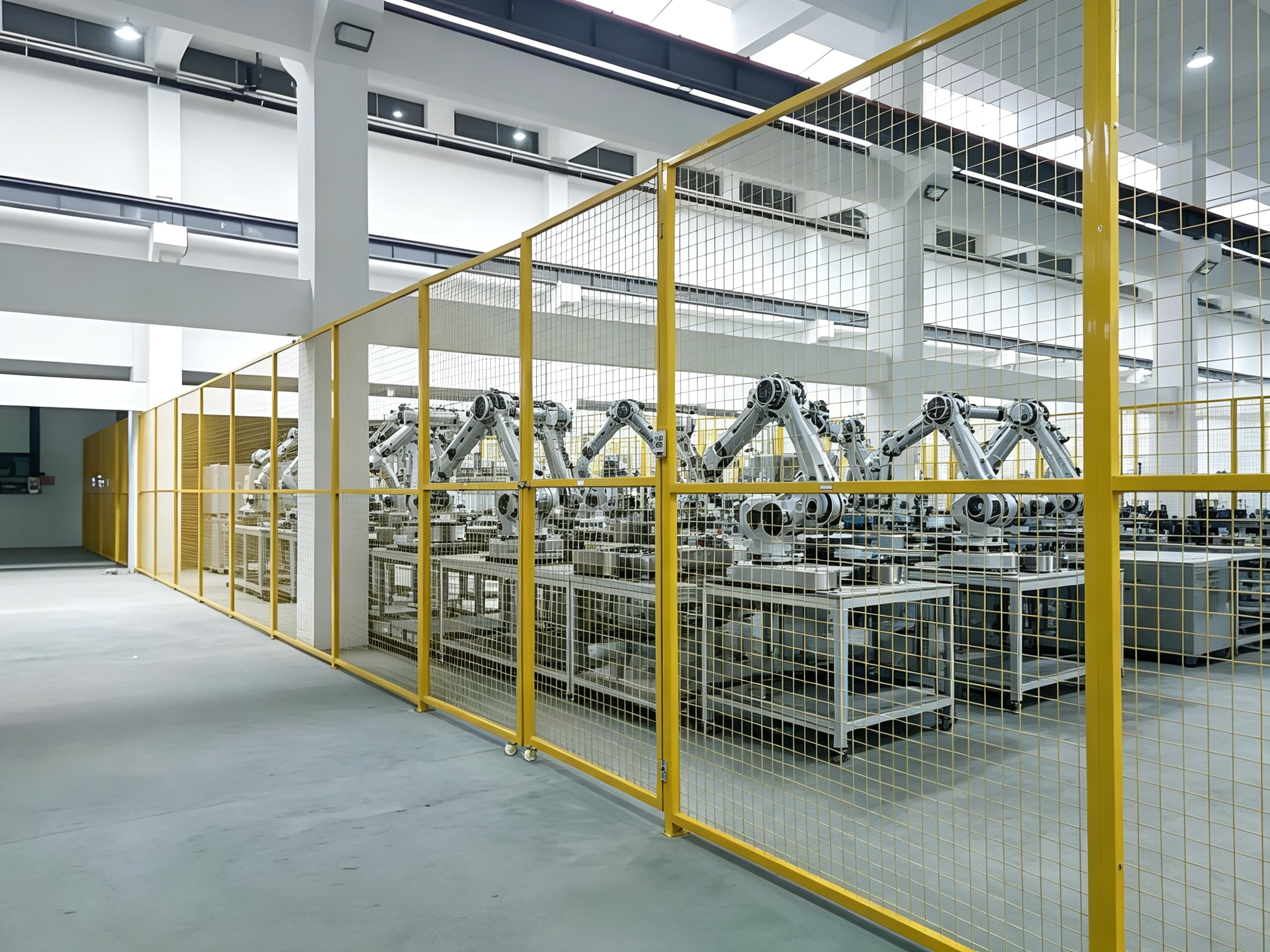
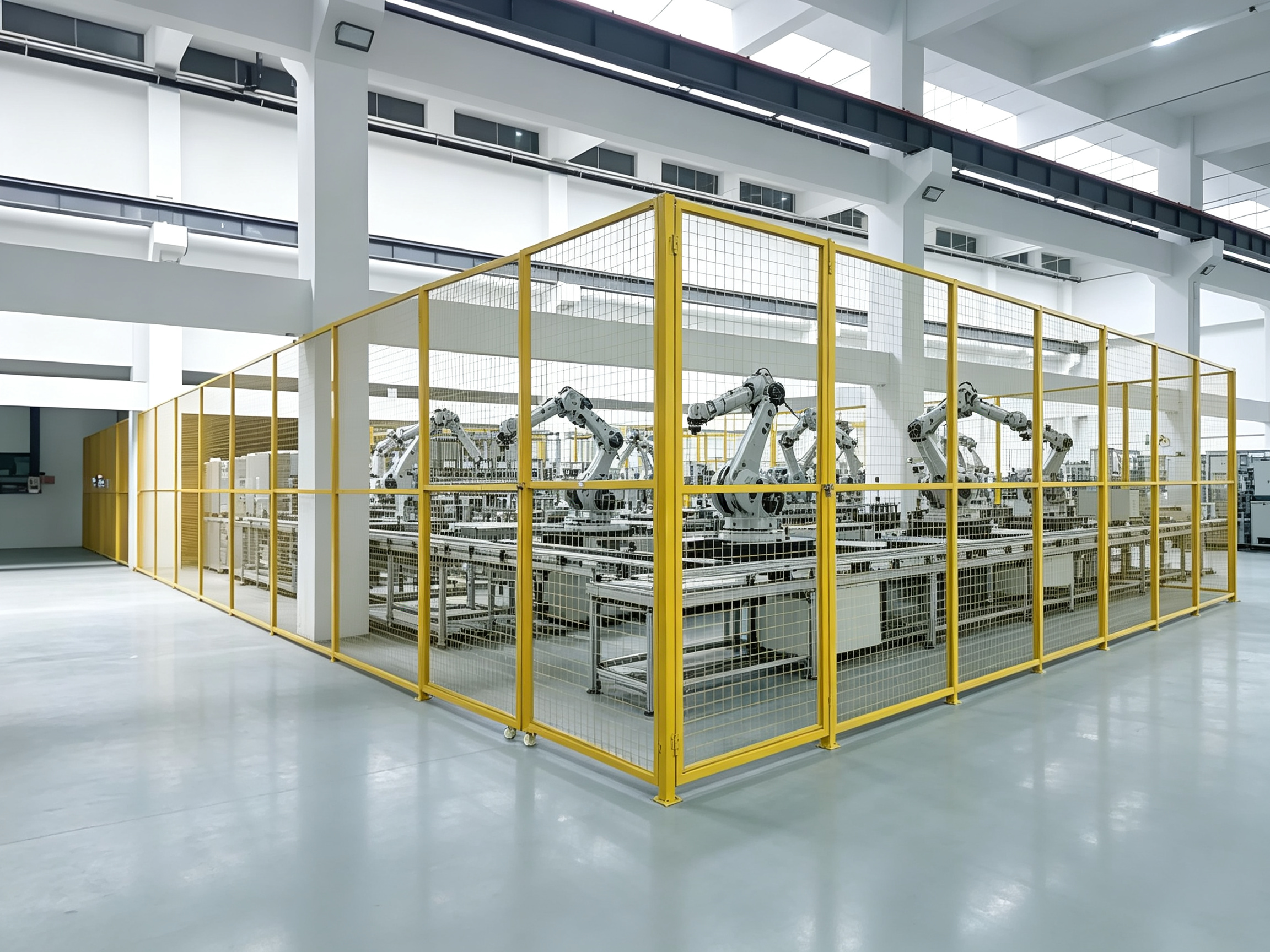
Modern intelligent warehouses are equipped with a large number of automated robots, conveyor lines, mechanical processing equipment and electrical control cabinets. These high-risk working areas are prohibited from unauthorized personnel access. Closed guarding fences form independent safety isolation zones to prevent staff from mistakenly entering mechanical operation areas and avoid extrusion, clamping and electric shock accidents.
High-Value Goods & Precision Storage Zones
For warehouse areas storing electronic accessories, precision instruments, high-value finished products and bonded goods, guarding fences can play a role in regional protection and standardized management. It effectively prevents irrelevant personnel from entering at will, avoids cargo confusion, loss and artificial damage, and ensures independent and orderly management of high-value storage areas.
Warehouse Rack & Key Facility Protection Areas
Storage racks, warehouse columns, fire-fighting facilities and power distribution equipment are core infrastructure of warehouse operation. Accidental forklift collision is the main cause of facility damage and structural instability. Guarding fences are installed around key facilities to buffer external impact, protect the stability of shelf structure and normal use of supporting facilities, and extend the service life of warehouse infrastructure.
Loading & Unloading Dock Transition Zones
The loading and unloading dock area has frequent vehicle access and chaotic personnel flow, with extremely uncertain safety risks. Reasonable arrangement of guarding fences can standardize the docking range of transport vehicles and the walking range of operators, avoid personnel falling from the platform and vehicle random docking, and standardize the safety management of the loading and unloading area.
Factory Workshop & Semi-Finished Product Zones
In integrated factories with production and storage functions, guarding fences are used to separate production operation areas, semi-finished product temporary storage areas and finished product warehouse areas. It realizes classified management of production and storage links, avoids cross-contamination of processes, and improves the overall standardized management level of the factory.
Difference Between Warehouse Guarding Fence & Ordinary Fence
Many project owners easily mix up warehouse guarding fences with ordinary perimeter fences and decorative railings, resulting in inappropriate selection and unqualified safety acceptance. The two have essential differences in functional positioning and application scenarios.
Different Functional Positioning
Warehouse guarding fences focus on internal operation safety and functional zoning, targeting collision prevention and risk isolation. Ordinary fences are mostly used for external perimeter enclosure and anti-theft isolation, with single protection function and no targeted industrial anti-collision performance.
Different Structural Performance
Warehouse guarding fences have thickened anti-collision structure and high stability, adapting to frequent mechanical impact. Ordinary decorative fences have weak bearing capacity, easy deformation and damage after slight impact, and cannot meet industrial safety standards.
Different Scene Adaptability
Warehouse guarding fences support flexible disassembly and layout adjustment, matching dynamic warehouse operation changes. Ordinary fixed fences are single in structure and difficult to adjust, unable to adapt to the flexible management needs of modern warehouses.
If you need OSHA-compliant, heavy-duty and flexible warehouse guarding fence solutions for your logistics warehouse, intelligent storage center or factory workshop, contact BDINDUSTRIAL. We provide free on-site safety assessment, personalized zoning design and factory direct supply services to help you build a standardized and safe warehouse operation system.
FAQ
1. What is the main purpose of a warehouse guarding fence?
The main purpose of a warehouse guarding fence is to build internal physical safety barriers for industrial storage sites. It standardizes functional zoning, separates pedestrians from forklift traffic, isolates hazardous mechanical operation areas, protects warehouse racks and core facilities from collision damage, and helps enterprises meet OSHA industrial safety audit standards, reducing on-site safety accidents and property losses.
2. Where are warehouse guarding fences most commonly installed?
Warehouse guarding fences are mainly installed in internal key risk areas of warehouses and factories, including pedestrian-vehicle separation aisles, automated robot work cells, high-value cargo storage areas, storage rack protection zones, electrical equipment isolation areas and loading and unloading dock transition zones, covering almost all links requiring safety isolation and standardized management.
3. Is warehouse guarding fence different from normal perimeter fence?
Yes, they are completely different. Warehouse guarding fences are designed for internal industrial safety and anti-collision zoning, with heavy-duty structure and flexible disassembly features. Normal perimeter fences focus on external anti-theft and enclosure, with weak anti-collision performance and single function, which cannot adapt to high-frequency forklift operation and dynamic layout adjustment of warehouses.
4. Do all industrial warehouses need to install guarding fences?
All standardized operating industrial warehouses and logistics centers need to install matching guarding fences. For sites with frequent forklift operation, mixed pedestrian-vehicle flow and automated equipment operation, guarding fences are mandatory safety facilities for daily risk prevention and safety audit compliance, effectively avoiding safety hazards caused by unstandardized on-site layout.
5. Can BDINDUSTRIAL customize guarding fences for different warehouse areas?
Absolutely yes. BDINDUSTRIAL provides targeted customized warehouse guarding fence solutions for different application scenarios. We can adjust fence height, structural strength, safety coating color and modular combination mode according to site risk level, space size and functional positioning, adapting to light storage, heavy industrial storage and intelligent warehouse management needs.